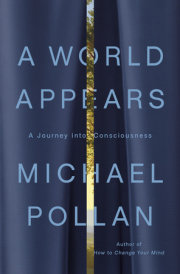
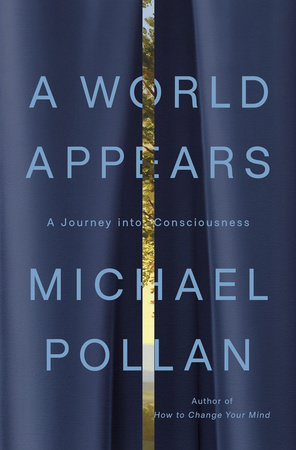
A World Appears

A Journey into Consciousness

Author Michael Pollan On Tour
Look inside
$32.00 US
Penguin Adult HC/TR | Penguin Press
12 per carton
On sale Feb 24, 2026 | 9781984881991
Sales rights: US, Canada, Open Mkt

See Additional Formats
"Pollan’s real genius—the word is not too strong—remains intact. That is his uncanny ability to scent the direction in which the culture is headed. He did it with food and psychedelics, and now, though A World Appears focuses on AI only intermittently, he has done it again." —Charles Finch, The Atlantic

From the #1 New York Times bestselling author of How to Change Your Mind, a panoptic exploration of consciousness—what it is, who has it, and why—and a meditation on the essence of our humanity


When it comes to the phenomenon that is consciousness, there is one point on which scientists, philosophers, and artists all agree: it feels like something to be us. Yet the fact that we have subjective experience of the world remains one of nature’s greatest mysteries. How is it that our mental operations are accompanied by feelings, thoughts, and a sense of self? What would a scientific investigation of our inner life look like, when we have as little distance and perspective on it as fish do of the sea? In A World Appears, Michael Pollan traces the unmapped continent that is consciousness, bringing radically different perspectives—scientific, philosophical, literary, spiritual and psychedelic—to see what each can teach us about this central fact of life.

When neuroscientists began studying consciousness in the early 1990s, they sought to explain how and why three pounds of spongy gray matter could generate a subjective point of view—assuming that the brain is the source of our perceived reality. Pollan takes us to the cutting edge of the field, where scientists are entertaining more radical (and less materialist) theories of consciousness. He introduces us to “plant neurobiologists” searching for the first flicker of consciousness in plants, scientists striving to engineer feelings into AI, and psychologists and novelists seeking to capture the felt experience of our slippery stream of consciousness.

In Pollan’s dazzling exploration of consciousness, he discovers a world far deeper and stranger than our everyday reality. Eye-opening and mind-expanding, A World Appears takes us into the laboratories of our own minds, ultimately showing us how we might make better use of the gift of awareness to more meaningfully connect with the world and our deepest selves.
Introduction
The Wager

In 1998, at a time when the modern science of consciousness was not even a decade old, two of its leading lights made a bet at a bar in Bremen late one night. Christof Koch was an intense young German American neuroscientist who had been in hot pursuit of the “neural correlates” of consciousness since the late 1980s. That’s when he, as a twenty‑eight‑year‑old postdoc at MIT, had teamed up with Francis Crick, one of the most revered scientists in the world. It was Crick who had, along with his colleagues, discovered the double‑ helical structure of DNA, solving one of the deepest puzzles of biology: how traits get passed down from one generation to the next. The discovery earned Crick and his colleagues a Nobel Prize in 1962 and gave him the confidence to believe that consciousness, perhaps the greatest mystery in science, would yield to the power of the same reductive approach that had cracked the code of life. In Koch, Crick had found a brilliant and energetic collaborator. Born in the Midwest to German parents in 1956, Koch had a PhD in what is now called computational neuroscience from Germany’s Max Planck Institute for Biological Cybernetics and would soon join the faculty at Caltech.

With Koch at his side, Crick set out to explain how it is that a particular piece of brain tissue generates the feeling of being alive—the sense of a self in possession of subjective experience. If not for Crick’s willingness to spend his considerable intellectual capital on it, the scientific study of consciousness might still be an intellectual backwater, not to mention a suicidal career move for a young neuroscientist or philosopher. For a sense of the subject’s standing at the time, consider this tart entry on consciousness in The International Dictionary of Psychology, first published in 1989: “A fascinating but elusive phenomenon: it is impossible to specify what it is, what it does, or why it evolved. Nothing worth reading has been written on it.”

But by 1998, Crick and Koch had published important papers that linked various measures of brain activity, such as specific frequencies of brain waves, to aspects of consciousness. It seemed only a matter of time before this approach would identify the specific neurons responsible for subjective experience—a physical signature of consciousness in the brain.

Not so fast, Koch’s drinking partner had argued that night. David Chalmers, an Australian‑born philosopher, thirty‑two at the time, had made a splash four years earlier at a consciousness conference in Tucson—remarkably enough, the very first interdisciplinary conference devoted to the subject. Chalmers was an unknown postdoc at Washington University in St. Louis when he spotted a notice for the Tucson conference; he had written his dissertation on consciousness* and thought maybe he could wangle an invitation to do a poster session outlining his approach. To his surprise, he was offered a speaking slot on the main stage.

With his long, stringy hair and boxy black jacket (think David Byrne circa 1984) over a concert T‑shirt, Chalmers looked more like a rock and roller than a respectable philosopher.* Before teeing up his own theories, he spent ten or twenty minutes framing the larger question of how best to approach the subject of consciousness by proposing that it be divided into two types of problems. First, there were what he called the “easy problems” of consciousness, which included figuring out the workings of mental operations like learning, memory, discrimination, and perception. Not all that easy, but at least we had a proven scientific method for approaching such behavioral and cognitive functions in terms of specific measures of brain activity. And then there was what he memorably called the “hard problem” of consciousness: the puzzle of why any of these mental operations are accompanied by any conscious experience whatsoever. “Why doesn’t all this information‑processing go on ‘in the dark,’ free of any inner feel?” he asked in a subsequent paper. Science, organized around objective third‑person measurement, was ill‑equipped to explain a phenomenon that was inherently subjective, qualitative, and internal. The power of science lay in its ability to reduce complex phenomena to simpler phenomena, as Crick had reduced heritability to the alphabet of DNA. Consciousness was fundamentally different, Chalmers argued, and would not yield to normal reductive science anytime soon, possibly ever. He speculated that the solution might well involve adding some‑ thing completely new—“an extra ingredient”—to the building blocks of reality identified by physics: matter, energy, space, and time.

No one remembers the theories of consciousness sketched out by the scruffy young philosopher that afternoon, but everyone remembers the meme he introduced—the hard problem—and the stiff challenge he thus laid at the feet of scientists, a challenge that, decades later, continues to shape and drive the field.

When the scientist and the philosopher met in Bremen in 1998, drinking together late into the night, Chalmers expressed doubt that the search for neural correlates would succeed in the foreseeable future, much less solve the hard problem even if it did. Koch, with the brashness of a young man backed by one of the most brilliant scientists of his time, proposed a wager: Within twenty‑five years, we would find the physical footprint of consciousness in the brain, which he predicted would comprise a small set of specialized neurons responsible for subjective experience. The loser would deliver to the winner a case of fine wine.*

How is it possible that the scientific study of consciousness is as new as it is? It’s not as if people were unacquainted with the phenomenon before the twentieth century. We need look no further than literature for accounts of conscious experience—for confirmation that, like Hamlet, we all inwardly talk to ourselves and experience spaces of interiority, not to mention the simple but nevertheless astounding fact that a world appears when we open our eyes. But these everyday miracles that are familiar to every one of us were not a central concern of
science until remarkably late in the last century.

The reason is not hard to find. Ever since Galileo’s time, and at his urging, science has cordoned off the mind—or the soul, as it was then known—leaving it to the exclusive jurisdiction of the priests and poets.* This was both a political move and a practical one—political be‑ cause it would (Galileo hoped) avoid bringing the hammer of the Church down on the scientific enterprise, and practical because (as Galileo foresaw) more progress could be made in the investigation of nature by focusing on objective qualitites that could be measured rather than on subjective qualities that could not. With a few notable exceptions along the way (I’m thinking of Sigmund Freud and American philosopher‑psychologist William James), this approach toward the science of the mind endured well into the twentieth century. Take, for example, behaviorism, the school of thought that dominated psychology for most of the twentieth century; it refused to deal with interiority or, really, anything but measurable outward behaviors. In light of this history, Christof Koch and David Chalmers stand out as pioneers.

I sometimes wonder which side of their bet I would have taken if given the opportunity back in 1998. It would have been a hard call. Part of me has always bristled at the arrogance of reductive science, which might explain why I’ve gravitated toward the humanities. I can still remember my eighth‑grade chemistry teacher, Mr. Sammis, a cocky materialist I found hard to stomach from day one. On the first day of class, Mr. Sammis thought it would astound us to learn that all we consisted of as human beings was a handful of elements and molecules, mostly H2O, carbon, and nitrogen. It followed that the most objective measure of our value was the cost of those compounds if purchased from a chemical‑supply company, which he pegged at four dollars and change, if I remember correctly. I was astounded—but mainly at what an idiot this man was for taking such a reductive view of life. In the throes of adolescence, fired with romantic passions (and confusion), I decided that day that chemistry had nothing important to teach me. Literature, on the other hand, captured something essential about what it felt like to be alive, something that would forever elude Mr. Sammis and his catalog of chemicals. That something, of course, was consciousness.

So this part of me surely would have taken Chalmers’s side of the bet. The hard problem was, in a sense, not only a recognition of the deep mystery but a defense of it: There’s something here (in our heads!) that you scientists can’t touch with your cold, hard assumptions and tools. Consciousness is singular, an extra and special ingredient in the recipe for making a life, one that can’t be ordered from the chemical supply house.

Yet there is another part of me, the part that became a science writer, that is sympathetic to the quest to explain everything in material or physical terms—that is, in terms of matter, energy, and gravity, which are, presumably, all there is: the complete ingredient list for everything, our bodies and minds included. This reductive project has an enviable track record of solving seemingly unsolvable mysteries. The emergence of life from a primordial soup of chemicals had long been such a mystery. People once spoke of an élan vital, or vital force, as the extra ingredient that somehow animated dead matter, transmuting it into living beings with intention and agency. For centuries, this was the hard problem of life, and while it hasn’t been completely solved, the mystery has gradually faded, thanks to the discoveries of people like Crick; we no longer need any magic ingredient to explain how life arose* from Darwin’s warm little pond. Surely it is only a matter of time before the mystery of consciousness yields before the power of science. At least that is what I believed before embarking on this journey, which has rocked many of the assumptions I held about the mind and its place in the world.†
“A coherent explanation of consciousness eludes modern science. In A World Appears, Michael Pollan dives headfirst into the mystery . . . He presents a captivating exploration, one that is highly personal and sensitive. Unlike with a book that simply reports the state of the consciousness field, we receive the story through the sharp mind of a writer and the questioning heart of a seeker . . . He confronts questions about the mind not as a neuroscience expert, but as an explorer, interviewing dozens of leading voices in science and proffering a rich survey of thinking in the field . . . There are, by some counts, 22 theories of consciousness, and Pollan examines many of them, always with a winning combination of awe and skepticism . . . A World Appears is highly pleasurable to read.” —David Eagleman, The New York Times Book Review

“Pollan’s real genius—the word is not too strong—remains intact. That is his uncanny ability to scent the direction in which the culture is headed. He did it with food and psychedelics, and now, though A World Appears focuses on AI only intermittently, he has done it again. By patiently mapping the problem that many of the creators of large language models claim, either cynically or foolishly, to be on the verge of solving, he brings this technology—which has come to dominate recent headlines, financial markets, and political debates—into a far more realistic light . . . A World Appears, with its admirable syncretic blend of empiricism and wonder before the limits of empiricism, steals back for humanity some of the sensation of miraculousness that this era has largely outsourced to technology.” —Charles Finch, The Atlantic

“Like all of Pollan’s books, in his latest work, the reader goes on a voyage of discovery with him as he interviews leading scientists and looks to literature, Indigenous epistemologies, psychology and even plants themselves for answers to questions that may not have answers. Along the way, he realizes that the ethical significance of his investigation is much greater than he first imagined. What consciousness is (and who has it), he writes, should at least give us pause as we consider how governments and corporations extract resources from arguably sentient ecosystems. He examines how careful we need to be as we develop AIs that may hold the capacity for their own suffering, whether we should be selling our own awareness to social media platforms in exchange for entertainment, how we treat animals and much more.” The Los Angeles Times

“Pollan has a knack for engaging my wonder at the sheer complexity of the world. For this experience alone, he is worth reading.” Pittsburgh Post-Gazette

“A fabulous and mind-expanding exploration of consciousness . . . Bridging both science and the humanities, Pollan mines neuroscientific research, philosophy, literature and his own mind, searching for different ways to think about being, and what it feels like . . . Pollan likens the study of consciousness to cosmology: just as we can only examine the universe from within it, there is no way for us to position ourselves outside our own consciousness . . . Pollan’s book attempts to disentangle the ideas we have inherited about our own minds, an inheritance of which we are not even aware . . . Pollan lives in the Bay Area of California, and, although his book rarely mentions Silicon Valley, it can be read as an act of resistance towards the financial and technological interests that are invested in distancing us from our inner lives and emotions.” —The Guardian

In A World Appears, Pollan draws on research by philosophers, psychologists, biologists, neuro-scientists, artificial intelligence (AI) pioneers, the tenets of Buddhism, and his own experience with psychedelics, to provide a mind-blowing examination of what we know, don’t know, and (since we must rely on our own consciousness to detect consciousness in others) may never know about the phenomenon.” —Psychology Today

“A World Appears
is a big, generous, illuminating and beautifully written inquiry into the essence of our being-in-the-world, of being, simply, alive . . . Now more than ever, in this age of untruth, we need to have our attention directed back to the fundamental questions—however hard they may be—as to the essential nature of our existence on this ailing planet. And as Michael Pollan richly demonstrates, questions are every bit as important as answers.”Financial Times

“Charming, witty, insightful, and eccentric . . . The book’s most moving descriptions of conscious experience can be found in Pollan’s accounts of losing his sense of self, first during a psychedelic mushroom trip and later during a Zen meditation in a cave . . . [A World Appears] is a wonderful phenomenological travelog.”Ned Block, Science

“This book seems to be not so much theoretical as experiential, with Pollan using many different lenses (neuroscience, psychology, philosophy, psychedelic) to explore the field in a personal manner . . . Great stuff.”New Scientist

“Enlightening . . . Pollan’s inquisitiveness makes him an accessible and entertaining guide through the 'labyrinth' of consciousness. Readers will be captivated by this tour of the inner workings of the mind.”Publishers Weekly

“A page-turner that explores the hidden world of the mind.”Kirkus (starred review)

“As a science writer who fully immerses himself in the questions of his work, Pollan’s consciousness itself is on full display, and this is thoroughly compelling reading.”Library Journal (starred review)

About

"Pollan’s real genius—the word is not too strong—remains intact. That is his uncanny ability to scent the direction in which the culture is headed. He did it with food and psychedelics, and now, though A World Appears focuses on AI only intermittently, he has done it again." —Charles Finch, The Atlantic

From the #1 New York Times bestselling author of How to Change Your Mind, a panoptic exploration of consciousness—what it is, who has it, and why—and a meditation on the essence of our humanity


When it comes to the phenomenon that is consciousness, there is one point on which scientists, philosophers, and artists all agree: it feels like something to be us. Yet the fact that we have subjective experience of the world remains one of nature’s greatest mysteries. How is it that our mental operations are accompanied by feelings, thoughts, and a sense of self? What would a scientific investigation of our inner life look like, when we have as little distance and perspective on it as fish do of the sea? In A World Appears, Michael Pollan traces the unmapped continent that is consciousness, bringing radically different perspectives—scientific, philosophical, literary, spiritual and psychedelic—to see what each can teach us about this central fact of life.

When neuroscientists began studying consciousness in the early 1990s, they sought to explain how and why three pounds of spongy gray matter could generate a subjective point of view—assuming that the brain is the source of our perceived reality. Pollan takes us to the cutting edge of the field, where scientists are entertaining more radical (and less materialist) theories of consciousness. He introduces us to “plant neurobiologists” searching for the first flicker of consciousness in plants, scientists striving to engineer feelings into AI, and psychologists and novelists seeking to capture the felt experience of our slippery stream of consciousness.

In Pollan’s dazzling exploration of consciousness, he discovers a world far deeper and stranger than our everyday reality. Eye-opening and mind-expanding, A World Appears takes us into the laboratories of our own minds, ultimately showing us how we might make better use of the gift of awareness to more meaningfully connect with the world and our deepest selves.

Excerpt

Introduction
The Wager

In 1998, at a time when the modern science of consciousness was not even a decade old, two of its leading lights made a bet at a bar in Bremen late one night. Christof Koch was an intense young German American neuroscientist who had been in hot pursuit of the “neural correlates” of consciousness since the late 1980s. That’s when he, as a twenty‑eight‑year‑old postdoc at MIT, had teamed up with Francis Crick, one of the most revered scientists in the world. It was Crick who had, along with his colleagues, discovered the double‑ helical structure of DNA, solving one of the deepest puzzles of biology: how traits get passed down from one generation to the next. The discovery earned Crick and his colleagues a Nobel Prize in 1962 and gave him the confidence to believe that consciousness, perhaps the greatest mystery in science, would yield to the power of the same reductive approach that had cracked the code of life. In Koch, Crick had found a brilliant and energetic collaborator. Born in the Midwest to German parents in 1956, Koch had a PhD in what is now called computational neuroscience from Germany’s Max Planck Institute for Biological Cybernetics and would soon join the faculty at Caltech.

With Koch at his side, Crick set out to explain how it is that a particular piece of brain tissue generates the feeling of being alive—the sense of a self in possession of subjective experience. If not for Crick’s willingness to spend his considerable intellectual capital on it, the scientific study of consciousness might still be an intellectual backwater, not to mention a suicidal career move for a young neuroscientist or philosopher. For a sense of the subject’s standing at the time, consider this tart entry on consciousness in The International Dictionary of Psychology, first published in 1989: “A fascinating but elusive phenomenon: it is impossible to specify what it is, what it does, or why it evolved. Nothing worth reading has been written on it.”

But by 1998, Crick and Koch had published important papers that linked various measures of brain activity, such as specific frequencies of brain waves, to aspects of consciousness. It seemed only a matter of time before this approach would identify the specific neurons responsible for subjective experience—a physical signature of consciousness in the brain.

Not so fast, Koch’s drinking partner had argued that night. David Chalmers, an Australian‑born philosopher, thirty‑two at the time, had made a splash four years earlier at a consciousness conference in Tucson—remarkably enough, the very first interdisciplinary conference devoted to the subject. Chalmers was an unknown postdoc at Washington University in St. Louis when he spotted a notice for the Tucson conference; he had written his dissertation on consciousness* and thought maybe he could wangle an invitation to do a poster session outlining his approach. To his surprise, he was offered a speaking slot on the main stage.

With his long, stringy hair and boxy black jacket (think David Byrne circa 1984) over a concert T‑shirt, Chalmers looked more like a rock and roller than a respectable philosopher.* Before teeing up his own theories, he spent ten or twenty minutes framing the larger question of how best to approach the subject of consciousness by proposing that it be divided into two types of problems. First, there were what he called the “easy problems” of consciousness, which included figuring out the workings of mental operations like learning, memory, discrimination, and perception. Not all that easy, but at least we had a proven scientific method for approaching such behavioral and cognitive functions in terms of specific measures of brain activity. And then there was what he memorably called the “hard problem” of consciousness: the puzzle of why any of these mental operations are accompanied by any conscious experience whatsoever. “Why doesn’t all this information‑processing go on ‘in the dark,’ free of any inner feel?” he asked in a subsequent paper. Science, organized around objective third‑person measurement, was ill‑equipped to explain a phenomenon that was inherently subjective, qualitative, and internal. The power of science lay in its ability to reduce complex phenomena to simpler phenomena, as Crick had reduced heritability to the alphabet of DNA. Consciousness was fundamentally different, Chalmers argued, and would not yield to normal reductive science anytime soon, possibly ever. He speculated that the solution might well involve adding some‑ thing completely new—“an extra ingredient”—to the building blocks of reality identified by physics: matter, energy, space, and time.

No one remembers the theories of consciousness sketched out by the scruffy young philosopher that afternoon, but everyone remembers the meme he introduced—the hard problem—and the stiff challenge he thus laid at the feet of scientists, a challenge that, decades later, continues to shape and drive the field.

When the scientist and the philosopher met in Bremen in 1998, drinking together late into the night, Chalmers expressed doubt that the search for neural correlates would succeed in the foreseeable future, much less solve the hard problem even if it did. Koch, with the brashness of a young man backed by one of the most brilliant scientists of his time, proposed a wager: Within twenty‑five years, we would find the physical footprint of consciousness in the brain, which he predicted would comprise a small set of specialized neurons responsible for subjective experience. The loser would deliver to the winner a case of fine wine.*

How is it possible that the scientific study of consciousness is as new as it is? It’s not as if people were unacquainted with the phenomenon before the twentieth century. We need look no further than literature for accounts of conscious experience—for confirmation that, like Hamlet, we all inwardly talk to ourselves and experience spaces of interiority, not to mention the simple but nevertheless astounding fact that a world appears when we open our eyes. But these everyday miracles that are familiar to every one of us were not a central concern of
science until remarkably late in the last century.

The reason is not hard to find. Ever since Galileo’s time, and at his urging, science has cordoned off the mind—or the soul, as it was then known—leaving it to the exclusive jurisdiction of the priests and poets.* This was both a political move and a practical one—political be‑ cause it would (Galileo hoped) avoid bringing the hammer of the Church down on the scientific enterprise, and practical because (as Galileo foresaw) more progress could be made in the investigation of nature by focusing on objective qualitites that could be measured rather than on subjective qualities that could not. With a few notable exceptions along the way (I’m thinking of Sigmund Freud and American philosopher‑psychologist William James), this approach toward the science of the mind endured well into the twentieth century. Take, for example, behaviorism, the school of thought that dominated psychology for most of the twentieth century; it refused to deal with interiority or, really, anything but measurable outward behaviors. In light of this history, Christof Koch and David Chalmers stand out as pioneers.

I sometimes wonder which side of their bet I would have taken if given the opportunity back in 1998. It would have been a hard call. Part of me has always bristled at the arrogance of reductive science, which might explain why I’ve gravitated toward the humanities. I can still remember my eighth‑grade chemistry teacher, Mr. Sammis, a cocky materialist I found hard to stomach from day one. On the first day of class, Mr. Sammis thought it would astound us to learn that all we consisted of as human beings was a handful of elements and molecules, mostly H2O, carbon, and nitrogen. It followed that the most objective measure of our value was the cost of those compounds if purchased from a chemical‑supply company, which he pegged at four dollars and change, if I remember correctly. I was astounded—but mainly at what an idiot this man was for taking such a reductive view of life. In the throes of adolescence, fired with romantic passions (and confusion), I decided that day that chemistry had nothing important to teach me. Literature, on the other hand, captured something essential about what it felt like to be alive, something that would forever elude Mr. Sammis and his catalog of chemicals. That something, of course, was consciousness.

So this part of me surely would have taken Chalmers’s side of the bet. The hard problem was, in a sense, not only a recognition of the deep mystery but a defense of it: There’s something here (in our heads!) that you scientists can’t touch with your cold, hard assumptions and tools. Consciousness is singular, an extra and special ingredient in the recipe for making a life, one that can’t be ordered from the chemical supply house.

Yet there is another part of me, the part that became a science writer, that is sympathetic to the quest to explain everything in material or physical terms—that is, in terms of matter, energy, and gravity, which are, presumably, all there is: the complete ingredient list for everything, our bodies and minds included. This reductive project has an enviable track record of solving seemingly unsolvable mysteries. The emergence of life from a primordial soup of chemicals had long been such a mystery. People once spoke of an élan vital, or vital force, as the extra ingredient that somehow animated dead matter, transmuting it into living beings with intention and agency. For centuries, this was the hard problem of life, and while it hasn’t been completely solved, the mystery has gradually faded, thanks to the discoveries of people like Crick; we no longer need any magic ingredient to explain how life arose* from Darwin’s warm little pond. Surely it is only a matter of time before the mystery of consciousness yields before the power of science. At least that is what I believed before embarking on this journey, which has rocked many of the assumptions I held about the mind and its place in the world.†

Praise

“A coherent explanation of consciousness eludes modern science. In A World Appears, Michael Pollan dives headfirst into the mystery . . . He presents a captivating exploration, one that is highly personal and sensitive. Unlike with a book that simply reports the state of the consciousness field, we receive the story through the sharp mind of a writer and the questioning heart of a seeker . . . He confronts questions about the mind not as a neuroscience expert, but as an explorer, interviewing dozens of leading voices in science and proffering a rich survey of thinking in the field . . . There are, by some counts, 22 theories of consciousness, and Pollan examines many of them, always with a winning combination of awe and skepticism . . . A World Appears is highly pleasurable to read.” —David Eagleman, The New York Times Book Review

“Pollan’s real genius—the word is not too strong—remains intact. That is his uncanny ability to scent the direction in which the culture is headed. He did it with food and psychedelics, and now, though A World Appears focuses on AI only intermittently, he has done it again. By patiently mapping the problem that many of the creators of large language models claim, either cynically or foolishly, to be on the verge of solving, he brings this technology—which has come to dominate recent headlines, financial markets, and political debates—into a far more realistic light . . . A World Appears, with its admirable syncretic blend of empiricism and wonder before the limits of empiricism, steals back for humanity some of the sensation of miraculousness that this era has largely outsourced to technology.” —Charles Finch, The Atlantic

“Like all of Pollan’s books, in his latest work, the reader goes on a voyage of discovery with him as he interviews leading scientists and looks to literature, Indigenous epistemologies, psychology and even plants themselves for answers to questions that may not have answers. Along the way, he realizes that the ethical significance of his investigation is much greater than he first imagined. What consciousness is (and who has it), he writes, should at least give us pause as we consider how governments and corporations extract resources from arguably sentient ecosystems. He examines how careful we need to be as we develop AIs that may hold the capacity for their own suffering, whether we should be selling our own awareness to social media platforms in exchange for entertainment, how we treat animals and much more.” The Los Angeles Times

“Pollan has a knack for engaging my wonder at the sheer complexity of the world. For this experience alone, he is worth reading.” Pittsburgh Post-Gazette

“A fabulous and mind-expanding exploration of consciousness . . . Bridging both science and the humanities, Pollan mines neuroscientific research, philosophy, literature and his own mind, searching for different ways to think about being, and what it feels like . . . Pollan likens the study of consciousness to cosmology: just as we can only examine the universe from within it, there is no way for us to position ourselves outside our own consciousness . . . Pollan’s book attempts to disentangle the ideas we have inherited about our own minds, an inheritance of which we are not even aware . . . Pollan lives in the Bay Area of California, and, although his book rarely mentions Silicon Valley, it can be read as an act of resistance towards the financial and technological interests that are invested in distancing us from our inner lives and emotions.” —The Guardian

In A World Appears, Pollan draws on research by philosophers, psychologists, biologists, neuro-scientists, artificial intelligence (AI) pioneers, the tenets of Buddhism, and his own experience with psychedelics, to provide a mind-blowing examination of what we know, don’t know, and (since we must rely on our own consciousness to detect consciousness in others) may never know about the phenomenon.” —Psychology Today

“A World Appears
is a big, generous, illuminating and beautifully written inquiry into the essence of our being-in-the-world, of being, simply, alive . . . Now more than ever, in this age of untruth, we need to have our attention directed back to the fundamental questions—however hard they may be—as to the essential nature of our existence on this ailing planet. And as Michael Pollan richly demonstrates, questions are every bit as important as answers.”Financial Times

“Charming, witty, insightful, and eccentric . . . The book’s most moving descriptions of conscious experience can be found in Pollan’s accounts of losing his sense of self, first during a psychedelic mushroom trip and later during a Zen meditation in a cave . . . [A World Appears] is a wonderful phenomenological travelog.”Ned Block, Science

“This book seems to be not so much theoretical as experiential, with Pollan using many different lenses (neuroscience, psychology, philosophy, psychedelic) to explore the field in a personal manner . . . Great stuff.”New Scientist

“Enlightening . . . Pollan’s inquisitiveness makes him an accessible and entertaining guide through the 'labyrinth' of consciousness. Readers will be captivated by this tour of the inner workings of the mind.”Publishers Weekly

“A page-turner that explores the hidden world of the mind.”Kirkus (starred review)

“As a science writer who fully immerses himself in the questions of his work, Pollan’s consciousness itself is on full display, and this is thoroughly compelling reading.”Library Journal (starred review)