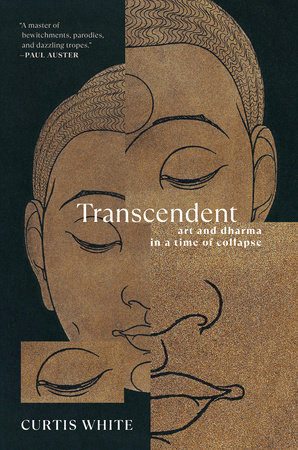
Transcendent

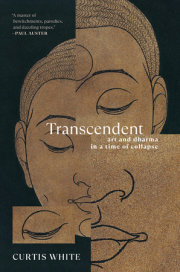
Art and Dharma in a Time of Collapse

Look inside
"Scholars of Buddhism will benefit from White’s shrewd takes." - Publishers Weekly

Acclaimed cultural critic Curtis White examines current fissures in Western Buddhism and argues against  the growth of scientific and corporate dharma, particularly in Stephen Batchelor's Secular Buddhist movement.

In Transcendent, celebrated cultural critic Curtis White, asks what Buddhism will look like in the future. Do we want a secular Buddhism that looks like corporations and neuroscience? Or do we want a Buddhism that still provides refuge from the debased world of money and things? Transcendence is not about magic realms where spirits fly about; the world is, as Shunryu Suzuki  put it, its own magic. We only need to reclaim it and reclaim our humanity while we’re at it.
 
The problem White suggests is a culture that recognizes only "things," capitalist things and science things, and aggressively denies the idea that the world of things has a beyond.  We're told by science ideologues like the New Atheists that we live in a secular age and that philosophy is dead, and art is only an amusement, and transcendence is not wanted because science can provide all the wonder and beauty we need.
 
Transcendent is a call for the re-enchantment not only of Buddhism but also of our Western art traditions. White recalls the risks and the raptures of the English Romantics, Beat poets, and the children of the counterculture, all in the name of a living world, and in defiance of our current world of climate catastrophe, contagious disease, and social collapse.
Prologue: The Hard Problem of Art

I was recently listening to Father John Misty’s first album Fear Fun on Spotify, and I noticed something that intrigued me. The songs I liked best were by a wide margin the favorite songs of many millions of other listeners. “Nancy From Now On” had fifty-two million listens. “Hollywood Forever Cemetery Sings” had forty million listens. But most other tracks on the album had only four to seven million listens. So I asked myself, “Why is that?” Not “Why do the songs have different counts” but “Why am I in such complete agreement with millions of other listeners about what the most-worthy songs are on this album?”

Perhaps it’s that the songs with smaller numbers are a reflection of how many people have listened to the entire album straight through, and that the staggeringly larger numbers represent repeat listens—many repeat listens. These songs are on “heavy rotation.” They are algorithmic hits. So, I wondered, “What is it about those songs that makes people want to listen to them again and again?” Ordinarily, we might explain it by simply saying they’re “better” or that we “love that song so much!” Or we might say, as many a music reviewer will, that they are the “best cuts,” as if that explains something. Or we avoid the problem by believing these numbers don’t reveal anything other than the arid fact that, for a short while, the songs “trended” or “went viral” or were “shared” on many playlists, a regular contagion of enthusiasm that is otherwise meaningless, a mere epiphenomenon of the digital age.

Or could it be the more complicated idea that those songs are more popular because of neurology?

That quite on their own, our brains experience major keys as positive and energetic, and minor keys or flatted keys like Db as introspective and sad, and a few of Misty’s songs just happen to hit the neurotransmitter sweet spot. And so the skillful manipulation of major and minor keys—from which The Beatles crafted song after song, as in “I’ll Cry Instead,” which moves so cunningly between G-major and a B-minor bridge—can produce a song that has been enjoyed for half a century and counting. In other words, the popularity of certain songs is only about a sort of biological demagoguery, our neural wiring saying, “You will like this song,” a pleasure pill provided courtesy of dopamine. Maybe that’s what we mean when we say, “That song is dope, man.”

Or is it possible to say there is something mysterious happening within music, including popular music, something that surpasses easy understanding? Is it that “Hollywood Cemetery” has “soul”? Does it have what Jack Kerouac called it, the ineffable, unknowable, unnameable moment in a sax solo where the jazz soars, finds a certain note and holds it, hoping never to let go? Is it that this quality of it unites us all somehow and that this unity is reflected even in Spotify’s debased number-chasing? Why does it feel to us that listening to this music is not something that we do, but something that happens to us? In which case, it’s not about numbers or brain chemistry at all. It’s about Chuck Berry’s Dionysian roustabout song “Rock and Roll Music”: dancing, drinking from wooden cups, listening to my man wail on the sax, everybody shook up. Or consider the experience of singers in a gospel choir. There’s nothing mysterious in their singing. It’s right there. The choir feels that spirit moving through it and they’re right—it is spirit welling up, spilling over, and put into our laps.
 
These are questions classical musicians and composers take seriously, too. I once had a conversation with Bill Cutter, composer and choral director at MIT. He pointed out that the big question is: How do we know that the acknowledged masters of classical music—Bach in particular—are better than other equally skillful but “minor” composers? Tartini is very good, Scarlatti is better, but Bach seems to have discovered the resonant secret to musical meaning. But how do we know Bach is better? And what do we mean by better?

This is the problem the poet Robert Browning riddled in his dramatic monologue about the Renaissance painter Andrea del Sarto. Del Sarto was a superior technician, but he envied Rafael because he reached “a heaven that’s shut to me.” Del Sarto was il miglior fabbro, the better technician, while Rafael “was flaming out his thoughts/Upon a palace-wall for Rome to see.” What del Sarto couldn’t understand was the flame, like the flame emerging from the head of a Thai Buddha. All he got for his efforts was a beautiful woman with expensive tastes who distracted him from anything blazing.

Like Browning, Cutter wondered about our “emotional response to music when no explanation for that response can be reasonably articulated.” He said:

I still cry every time I hear the second movement of the Ravel Piano Concerto in G. There is something intensely personal and profoundly sad about its meandering E major tune. No amount of musical analysis can address this . . . thank God. I’m sure you know that famous Stravinsky quote, “Music is, by its very nature, essentially powerless to express anything at all.” He’s right ... and that’s what’s so magical and baffling!

Arnold Schoenberg—the last of the Wagnerians, and the first of the modernists—agreed with Cutter and Stravinsky in writing: “Music does not express the extra-musical,” but he added, “the composer conceives an entire composition as a spontaneous vision.” But a vision of what? Not of the music as the mathematical progression of chords and rhythms, because “the composer does not ... add bit by bit, as a child does in building with wooden blocks.” For Schoenberg, music is not in any way a mechanism, although it may be for the individual musician, busily counting and watching the conductor’s baton. For Schoenberg, musicians may be artists, but the composer is a creator, with all of the suggestions of divinity that word implies.

And so the question remains: How do we know that, for example, Gustav Mahler was “better” than other composers? What is it that we hear in his music that is “better”? And how was it that, fallen though the world he lived in certainly was, somehow they—the vague, massive public—knew that Mahler’s music took them somewhere they’d never been before, somewhere that felt like their lives had been illuminated? Even more confusing, Mahler was a Jew. Anti-Semitic Vienna didn’t want to like the Jew, so why did it? What did the Viennese hear in him?

As Mahler knew quite thoroughly, the privileged audiences that came to his concerts only wanted to be seen among those who should be seen and maybe entertained a little. So how did they know that Mahler was the One, der Mahler? Why did they pass Mahler along to future people more or less like themselves, worldly people, people proud in their delusions, often cruel people? Why did they know that Mahler was more important than their prejudices, their sensualities, and their vanities?

It reminds me of a story about Paul McCartney visiting Dustin Hoffman back in the day. Paul was playing guitar and composing the song “Picasso’s Last Words,” and Hoffman gasped and said, “Look, he’s doing it! He’s doing it!”

But what was he doing? And what was the “it”?
“Why has the West become so fascinated by Buddhism — making it the most popular non-Western tradition? Because Buddhist views of transcendence resonate so deeply with important aspects of our own culture. Curtis White’s Transcendent lovingly explores many of these parallels and interactions. It helps me understand better my attraction to both.” — David Loy, author of Ecodharma: Buddhist Teachings for the Ecological Crisis

"Provocative...[Transcendent] amounts to a convincing case that will resonate with progressives seeking to 'free ourselves from the [capitalistic] world that we were born into' and 'change the way we live.' Scholars of Buddhism will benefit from White’s shrewd takes." — Publishers Weekly

"I don't have much extra reading time, but I read Transcendent: Art and Dharma in a Time of Collapse twice....With urgency, warmth, and incisive prose, White [questions] what it is we're practicing if the practice is apologetic, devoid of mystery, and reduced to something that helps us adjust more comfortably to a world of delusion and harm."— Lion's Roar


About

"Scholars of Buddhism will benefit from White’s shrewd takes." - Publishers Weekly

Acclaimed cultural critic Curtis White examines current fissures in Western Buddhism and argues against  the growth of scientific and corporate dharma, particularly in Stephen Batchelor's Secular Buddhist movement.

In Transcendent, celebrated cultural critic Curtis White, asks what Buddhism will look like in the future. Do we want a secular Buddhism that looks like corporations and neuroscience? Or do we want a Buddhism that still provides refuge from the debased world of money and things? Transcendence is not about magic realms where spirits fly about; the world is, as Shunryu Suzuki  put it, its own magic. We only need to reclaim it and reclaim our humanity while we’re at it.
 
The problem White suggests is a culture that recognizes only "things," capitalist things and science things, and aggressively denies the idea that the world of things has a beyond.  We're told by science ideologues like the New Atheists that we live in a secular age and that philosophy is dead, and art is only an amusement, and transcendence is not wanted because science can provide all the wonder and beauty we need.
 
Transcendent is a call for the re-enchantment not only of Buddhism but also of our Western art traditions. White recalls the risks and the raptures of the English Romantics, Beat poets, and the children of the counterculture, all in the name of a living world, and in defiance of our current world of climate catastrophe, contagious disease, and social collapse.

Excerpt

Prologue: The Hard Problem of Art

I was recently listening to Father John Misty’s first album Fear Fun on Spotify, and I noticed something that intrigued me. The songs I liked best were by a wide margin the favorite songs of many millions of other listeners. “Nancy From Now On” had fifty-two million listens. “Hollywood Forever Cemetery Sings” had forty million listens. But most other tracks on the album had only four to seven million listens. So I asked myself, “Why is that?” Not “Why do the songs have different counts” but “Why am I in such complete agreement with millions of other listeners about what the most-worthy songs are on this album?”

Perhaps it’s that the songs with smaller numbers are a reflection of how many people have listened to the entire album straight through, and that the staggeringly larger numbers represent repeat listens—many repeat listens. These songs are on “heavy rotation.” They are algorithmic hits. So, I wondered, “What is it about those songs that makes people want to listen to them again and again?” Ordinarily, we might explain it by simply saying they’re “better” or that we “love that song so much!” Or we might say, as many a music reviewer will, that they are the “best cuts,” as if that explains something. Or we avoid the problem by believing these numbers don’t reveal anything other than the arid fact that, for a short while, the songs “trended” or “went viral” or were “shared” on many playlists, a regular contagion of enthusiasm that is otherwise meaningless, a mere epiphenomenon of the digital age.

Or could it be the more complicated idea that those songs are more popular because of neurology?

That quite on their own, our brains experience major keys as positive and energetic, and minor keys or flatted keys like Db as introspective and sad, and a few of Misty’s songs just happen to hit the neurotransmitter sweet spot. And so the skillful manipulation of major and minor keys—from which The Beatles crafted song after song, as in “I’ll Cry Instead,” which moves so cunningly between G-major and a B-minor bridge—can produce a song that has been enjoyed for half a century and counting. In other words, the popularity of certain songs is only about a sort of biological demagoguery, our neural wiring saying, “You will like this song,” a pleasure pill provided courtesy of dopamine. Maybe that’s what we mean when we say, “That song is dope, man.”

Or is it possible to say there is something mysterious happening within music, including popular music, something that surpasses easy understanding? Is it that “Hollywood Cemetery” has “soul”? Does it have what Jack Kerouac called it, the ineffable, unknowable, unnameable moment in a sax solo where the jazz soars, finds a certain note and holds it, hoping never to let go? Is it that this quality of it unites us all somehow and that this unity is reflected even in Spotify’s debased number-chasing? Why does it feel to us that listening to this music is not something that we do, but something that happens to us? In which case, it’s not about numbers or brain chemistry at all. It’s about Chuck Berry’s Dionysian roustabout song “Rock and Roll Music”: dancing, drinking from wooden cups, listening to my man wail on the sax, everybody shook up. Or consider the experience of singers in a gospel choir. There’s nothing mysterious in their singing. It’s right there. The choir feels that spirit moving through it and they’re right—it is spirit welling up, spilling over, and put into our laps.
 
These are questions classical musicians and composers take seriously, too. I once had a conversation with Bill Cutter, composer and choral director at MIT. He pointed out that the big question is: How do we know that the acknowledged masters of classical music—Bach in particular—are better than other equally skillful but “minor” composers? Tartini is very good, Scarlatti is better, but Bach seems to have discovered the resonant secret to musical meaning. But how do we know Bach is better? And what do we mean by better?

This is the problem the poet Robert Browning riddled in his dramatic monologue about the Renaissance painter Andrea del Sarto. Del Sarto was a superior technician, but he envied Rafael because he reached “a heaven that’s shut to me.” Del Sarto was il miglior fabbro, the better technician, while Rafael “was flaming out his thoughts/Upon a palace-wall for Rome to see.” What del Sarto couldn’t understand was the flame, like the flame emerging from the head of a Thai Buddha. All he got for his efforts was a beautiful woman with expensive tastes who distracted him from anything blazing.

Like Browning, Cutter wondered about our “emotional response to music when no explanation for that response can be reasonably articulated.” He said:

I still cry every time I hear the second movement of the Ravel Piano Concerto in G. There is something intensely personal and profoundly sad about its meandering E major tune. No amount of musical analysis can address this . . . thank God. I’m sure you know that famous Stravinsky quote, “Music is, by its very nature, essentially powerless to express anything at all.” He’s right ... and that’s what’s so magical and baffling!

Arnold Schoenberg—the last of the Wagnerians, and the first of the modernists—agreed with Cutter and Stravinsky in writing: “Music does not express the extra-musical,” but he added, “the composer conceives an entire composition as a spontaneous vision.” But a vision of what? Not of the music as the mathematical progression of chords and rhythms, because “the composer does not ... add bit by bit, as a child does in building with wooden blocks.” For Schoenberg, music is not in any way a mechanism, although it may be for the individual musician, busily counting and watching the conductor’s baton. For Schoenberg, musicians may be artists, but the composer is a creator, with all of the suggestions of divinity that word implies.

And so the question remains: How do we know that, for example, Gustav Mahler was “better” than other composers? What is it that we hear in his music that is “better”? And how was it that, fallen though the world he lived in certainly was, somehow they—the vague, massive public—knew that Mahler’s music took them somewhere they’d never been before, somewhere that felt like their lives had been illuminated? Even more confusing, Mahler was a Jew. Anti-Semitic Vienna didn’t want to like the Jew, so why did it? What did the Viennese hear in him?

As Mahler knew quite thoroughly, the privileged audiences that came to his concerts only wanted to be seen among those who should be seen and maybe entertained a little. So how did they know that Mahler was the One, der Mahler? Why did they pass Mahler along to future people more or less like themselves, worldly people, people proud in their delusions, often cruel people? Why did they know that Mahler was more important than their prejudices, their sensualities, and their vanities?

It reminds me of a story about Paul McCartney visiting Dustin Hoffman back in the day. Paul was playing guitar and composing the song “Picasso’s Last Words,” and Hoffman gasped and said, “Look, he’s doing it! He’s doing it!”

But what was he doing? And what was the “it”?

Praise

“Why has the West become so fascinated by Buddhism — making it the most popular non-Western tradition? Because Buddhist views of transcendence resonate so deeply with important aspects of our own culture. Curtis White’s Transcendent lovingly explores many of these parallels and interactions. It helps me understand better my attraction to both.” — David Loy, author of Ecodharma: Buddhist Teachings for the Ecological Crisis

"Provocative...[Transcendent] amounts to a convincing case that will resonate with progressives seeking to 'free ourselves from the [capitalistic] world that we were born into' and 'change the way we live.' Scholars of Buddhism will benefit from White’s shrewd takes." — Publishers Weekly

"I don't have much extra reading time, but I read Transcendent: Art and Dharma in a Time of Collapse twice....With urgency, warmth, and incisive prose, White [questions] what it is we're practicing if the practice is apologetic, devoid of mystery, and reduced to something that helps us adjust more comfortably to a world of delusion and harm."— Lion's Roar