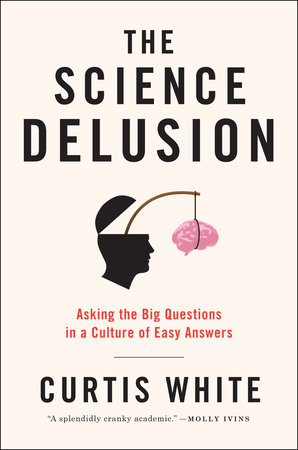
One of our most brilliant social critics—author of the bestselling The Middle Mind—presents a scathing critique of the “delusions” of science alongside a rousing defense of the tradition of Romanticism and the “big” questions.
With the rise of religion critics such as Richard Dawkins, and of pseudo-science advocates such as Malcolm Gladwell and Jonah Lehrer, you’re likely to become a subject of ridicule if you wonder “Why is there something instead of nothing?” or “What is our purpose on earth?” Instead, at universities around the world, and in the general cultural milieu, we’re all being taught that science can resolve all questions without the help of philosophy, politics, or the humanities.
In short, the rich philosophical debates of the 19th century have been nearly totally abandoned, argues critic Curtis White. An atheist himself, White nonetheless calls this new turn “scientism”—and fears what it will do to our culture if allowed to flourish without challenge. In fact, in “scientism” White sees a new religion with many unexamined assumptions.
In this brilliant multi-part critique, he aims at a TED talk by a distinguished neuroscientist in which we are told that human thought is merely the product of our “connectome,” a map of neural connections in the brain that is yet to be fully understood. . . . He whips a widely respected physicist who argues that our new understanding of the origins of the universe obviates any philosophical inquiry . . . and ends with a learned defense of the tradition of Romanticism, which White believes our technology and science-obsessed world desperately needs to rediscover.
It’s the only way, he argues, that we can see our world clearly. . . and change it.
Praise for The Middle Mind:
“Cogent, acute, beautiful, and true.” —David Foster Wallace
“A splendidly cranky academic.” —Molly Ivins
“The most inspiringly wicked social critic of the moment.” —Will Blythe, Elle
“At first, The Middle Mind looks simply like this season’s lefty screed but where White departs from most liberal ranters is that he doesn’t blame the stupidizing of America on brainwashing or sinister corporations. He blames you and me.” —John Colapinto, Rolling Stone
One of our most brilliant social critics—author of the bestselling The Middle Mind—presents a scathing critique of the “delusions” of science alongside a rousing defense of the tradition of Romanticism and the “big” questions.
With the rise of religion critics such as Richard Dawkins, and of pseudo-science advocates such as Malcolm Gladwell and Jonah Lehrer, you’re likely to become a subject of ridicule if you wonder “Why is there something instead of nothing?” or “What is our purpose on earth?” Instead, at universities around the world, and in the general cultural milieu, we’re all being taught that science can resolve all questions without the help of philosophy, politics, or the humanities.
In short, the rich philosophical debates of the 19th century have been nearly totally abandoned, argues critic Curtis White. An atheist himself, White nonetheless calls this new turn “scientism”—and fears what it will do to our culture if allowed to flourish without challenge. In fact, in “scientism” White sees a new religion with many unexamined assumptions.
In this brilliant multi-part critique, he aims at a TED talk by a distinguished neuroscientist in which we are told that human thought is merely the product of our “connectome,” a map of neural connections in the brain that is yet to be fully understood. . . . He whips a widely respected physicist who argues that our new understanding of the origins of the universe obviates any philosophical inquiry . . . and ends with a learned defense of the tradition of Romanticism, which White believes our technology and science-obsessed world desperately needs to rediscover.
It’s the only way, he argues, that we can see our world clearly. . . and change it.
Praise
Praise for The Middle Mind:
“Cogent, acute, beautiful, and true.” —David Foster Wallace
“A splendidly cranky academic.” —Molly Ivins
“The most inspiringly wicked social critic of the moment.” —Will Blythe, Elle
“At first, The Middle Mind looks simply like this season’s lefty screed but where White departs from most liberal ranters is that he doesn’t blame the stupidizing of America on brainwashing or sinister corporations. He blames you and me.” —John Colapinto, Rolling Stone