See You on the Other Side

A Novel

Author Jay McInerney On Tour
$22.00 US
Audio | Random House Audio
On sale Apr 14, 2026 | 8 Hours and 0 Minutes | 9798217174416
Sales rights: US, Canada, Open Mkt

See Additional Formats
Once again brilliantly combining the lyrical observation of F. Scott Fitzgerald with the laser-bright social satire of Evelyn Waugh, Jay McInerney gives us the stunningly accomplished and profoundly affecting final volume in the tetralogy charting the marriage of Russell and Corrinne Calloway, now in their sixties, against the backdrop of various crises that have bedeviled our society in the past forty years.

The celebration of the thirty-fifth wedding anniversary of Russell Calloway’s best friend, Washington Lee—the least likely monogamist of his acquaintance somehow having become over the years a model husband and father—at the Odeon in the Spring of 2020 sparks an at once funny and moving autumnal reckoning with mortality as the specter of the Covid-19 virus spreads. In this moment of unprecedented upheaval—frantic and fraught real-time response, piercing personal and political impact—the Calloways find themselves and their marriage tested in ways they could never have anticipated as fatal consequences ensue.
1

Stepping out of the cab into the twilight, he felt a rush of nostalgia at the sight of the red-­and-­white neon sign hovering above West Broadway like an old movie title materializing on a dark screen. Like the start of a film set in New York, it signaled a certain promise—­the promise of metropolitan pleasure, of social and gustatory and erotic adventures. The evening was freighted with possibility. The Odeon was one of the surviving landmarks of the protean city he’d inhabited for almost four decades, teeming with memories, layers of personal history, ghosts: prenightclub dinners with the boys punctuated by trips downstairs to the bathroom to snort cocaine, which made him feel as if he would live forever and the night would never end, bounding up the stairs afterward as if on springs to ogle the models and pretend not to notice the famous actors and painters at the adjoining tables; business dinners where he’d wooed authors he was hoping to sign, back when young novelists were the toast of the town, overnight celebrities who appeared in the gossip columns as well as the book pages; meetings to plot a hostile takeover of the publishing company that was his first employer and almost succeeding in buying it with borrowed money before the stock market crash of ’87 had derailed that plan, the end of the overreach of his youth; recent lunches with Condé Nasters after their offices moved into the new World Trade Center that had risen ever so slowly from the ashes of the Twin Towers; date nights with his wife, Corrine, when they’d lived around the corner in an old-­school loft with pressed-­tin ceilings and warped plank floors over which they crept carefully on returning home so as not to trip and fall in their tipsiness and wake their kids; and lunches as a family, the kids venturing beyond grilled cheese to croque monsieurs. He hadn’t been here in several years, and he found it reassuring that it endured, that the restaurant was waiting, unchanged, long after the monumental towers had fallen and the rented loft where his children grew up had been gutted and combined with the one above to make a deluxe duplex, although its survival also induced a nostalgia for all that had disappeared, for the declension of its bright, shining moment in the history of the city, just as its artful retro design conjured a lost city of Edward Hopperesque luncheonettes and cafeterias—­like a layer of myth below the sedimentary strata of memory.

Russell’s best friend, Washington Lee, had taken over the restaurant for the night to celebrate his thirty-­fifth wedding anniversary—­the least likely monogamist of his acquaintance somehow becoming over the years a model husband and father, as if to illustrate the fact that each marriage is a mystery, an iceberg of which only a fraction is visible from the outside, above the surface. His own wife took his arm now on the sidewalk, illuminated by the sinking sun of the magic hour, looking up at him and locking eyes, a ritual of affirmation, a mutual recognition of their union before they entered public space. They’d been together so long that it was sometimes hard to really see her, hard not to see instead the ghost of the girl she’d been when they first entered these doors, but tonight he scrutinized her closely, and he was happy with what he saw—­to his eyes still a fine-­looking woman after all these years, despite the lines etching her face. Yes, she’d had a brow lift seven or eight years ago, something to which he strenuously objected at the time but had come to approve of as the results were so pleasing. He’d been afraid she would look different, that he wouldn’t recognize the face he loved, but in fact she looked more like herself, more like the girl he’d fallen in love with. I don’t recognize myself in the mirror, she’d said, arguing her case. It was a small victory against the relentless onslaught of age, which they were nevertheless losing every day. He knew he was thicker and softer in the middle, his forehead corrugated with age, creased from his nostrils to the ends of his lips, wattled in the chin. They’d both turned sixty a couple of years ago.

Their brief communion was punctuated by familiar voices, shrill soprano Nancy Tanner and her alto husband calling their names, greetings and questions from the scrum of familiars on the sidewalk outside the door, a scene that resembled the preludes to a thousand other gatherings, so familiar they could perform their roles by rote, and for a moment as they drifted toward the door all seemed reassuringly familiar, and then he remembered, feeling Corrine slowing as they approached the group, catching himself before he succumbed to the customary hugging and cheek kissing, refraining, or trying to refrain, since some of their friends hadn’t gotten the memo, Nancy Tanner coming in close and nailing his cheek even as Russell extended an elbow toward her husband, trying out the new greeting in this time of incipient plague, Corrine holding back on the sidewalk in an attempt to circumvent the confusion. She waved to the group, waiting till they were sucked into the interior before taking Russell’s arm and surrendering to the inevitable. She was very concerned about the virus that had infiltrated their city, convinced that it posed a serious threat, and as they gingerly navigated the room, they found others who shared her concern.

“I kind of can’t believe we’re here,” said Dave Whitlock, an old colleague. Russell hadn’t seen him in years, though neither acknowledged this fact. More than he himself, Russell thought, Whitlock looked his age, and then some, white-­haired and wattled of chin.

Thinking of the old days, Russell said, “You mean, at the Odeon.”

“No, I mean—­did they even consider canceling this shindig?”

“And yet, you insisted on coming,” his wife said—­Russell could not for the life of him remember her name.

“Twenty confirmed guests canceled today,” Corrine said. “I talked to Veronica a couple of hours ago.”

“I wish we’d canceled,” said Mrs. Whitlock.

“Russell wouldn’t hear of it,” Corrine said. “He thinks I’m an alarmist. But then, I’ve never yet been able to talk him out of attending a party. Why should an impending plague be a reason to stay home?”

“I don’t know. This virus scare just seems a little overblown to me,” Russell said.

“Russell’s prefrontal cortex never fully developed,” Corrine said. “He still has an adolescent sense of invulnerability.”

“That’s a little harsh. I prefer to think of myself as an optimist.”

“You’re an optimist, all right,” she said, not unkindly. “I kept thinking you’d get more realistic with age.”

Realism is just another word for resignation.

“Russell was always famously Panglossian,” Whitlock said.

In fact, Whitlock’s version of Russell was at least twenty years out-­of-­date, but then, he didn’t think his essential character had really changed. He didn’t believe most other people really changed, over time, although it was a fundamental premise of literary fiction, self-­help books, and Alcoholics Anonymous that they could. Does Mr. Darcy change during his pursuit of Elizabeth Bennet? Or does he merely polish his manners? Russell had taken some hits, suffered some serious disappointments. He had scars. He’d lost friends, loved ones, battles. He thought he had a healthy sense of realism, but he would never be a cynic. Had Wash­ing­ton changed? Perhaps. Mellowed, certainly. Age an agent of gradual change, for sure.

“I like to think I’m a little more nuanced than that,” he said.

“You know his nickname, right?” Whitlock asked his wife. “Crash Calloway.”

“Oh, God, yes, I haven’t heard that one in years,” Corrine said.

Mrs. Whitlock didn’t get it. “Why ‘Crash’?”

“A certain heedless enthusiasm,” Corrine explained, “a lack of guile and subtlety and more specifically a lack of acute spatial awareness. He tends to plunge forward, literally and figuratively, without anticipating obstacles, sometimes colliding with said obstacles.”

“Are we talking about Biden,” asked their host, joining the conversation. Stately, tall and lean, Washington had, it seemed to Russell, acquired a certain gravity of bearing in his later years.

“Yes, let’s by all means talk about Biden,” Russell said.

“Talk about pulling a Lazarus. Fucking guy was dead in the water before Tuesday. His old pasty white face looking more and more like that of a drowned man. Suddenly saved by the Black folks.”

“Now maybe we won’t have to feel the Bern,” Whitlock said.

Since Super Tuesday, the relief among middle-­aged, upper-­middle-­class liberal Manhattan Democrats, who formed a majority in the room, was palpable.

“Ah yes, Uncle Joe,” Washington said. “I’m not sure I entirely understand the enthusiasm of African American voters in South Carolina and elsewhere for Uncle Joe. Didn’t he once brag about working with segregationists, who opposed busing in the seventies and who helped craft the disastrous Clinton crime bill in ’94 which helped put millions of Black men in jail. As what you people call a person of color, I’m not a fan.”

“Understood,” said Whitlock, “but if the goal is to defeat Trump, he may be our best hope.” Russell was reminded anew of Whitlock’s gift for dispensing conventional wisdom.

“No doubt that’s what you said about Hillary in ’16,” Washington said. “That worked out well.”

Washington loved being the contrarian, loved setting white people back on their heels.

“I’m pretty sure that’s what we said about Walter Mondale back in ’84 when we first started coming here,” said Russell. “That he could beat Reagan.”

“Oh, God, are we that old?” said Corrine. “Walter Mondale?”

“Yes, I’m afraid we are,” Washington said. “We arrived in the city not long after Reagan arrived in D.C. Ah, yes, I remember having drinks here on election night in ’84, talking with Paulina Porizkova at the bar.”

“Remember the night you had to fend off Andy Warhol,” Russell said to Washington. “In this very room.”

“I think he mistook me for Basquiat,” Washington said.

“You didn’t have the hair.”

“I had a lot more then.”

Russell said, “I once shared a few lines with him down in the bathroom.” Which was almost true. Russell had come out of a bathroom stall after snorting a few and found Basquiat standing at the sink, dipping a key into a paper packet, leaning backward so as to keep his dreads out of the equation. That was Russell’s Basquiat story. Over time, he’d embellished the story slightly to the point that he almost believed he’d done coke with Basquiat. If he’d been smart, he would have bought a painting back then. Warhol and Basquiat both dead a few years later—­’88, was it—­hard to believe it was more than thirty years ago. A lot of Russell’s memories of that period had this quality of being enhanced and burnished and supplemented by all that had been written subsequently about what was now enshrined in the collective consciousness as a golden age of New York. They had been there, lived through it, but the passage of time had dulled and smudged their recollections, and they were eager to fill the gaps with the testimony of other witnesses. Russell had reached a point where he’d forgotten far more than he remembered about those days.

The photographer Glenda Banes was indignant. “I mean, what the hell were they thinking,” she asked, tucking her stringy hair back behind her ears. “If I get sick and die, I’m coming back to haunt their asses. If I get sick and live, I’ll sue.”

“Did you think about just canceling,” Russell asked.

“Everyone knows I hate to miss a party,” she said.

Glenda hadn’t missed many parties as far as Russell could tell. He had, in fact, attended one for the opening of her retrospective at MoMA recently, where she’d worn a sleeveless dress that highlighted the pacemaker, like a small third breast, she’d had implanted at the top of her rib cage after triple bypass surgery. These days she was far too illustrious, and expensive, to take photos of authors who weren’t Nobel laureates, though she’d once, decades ago, given Russell the rights to a photograph of Jeff Pierce that became the dust-­jacket image on his posthumous novel.
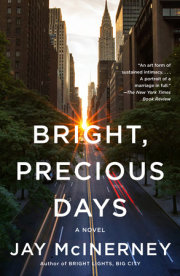
“As a culmination of the Calloway tetralogy, the novel offers an exquisite meditation on mortality, resilience, and cultural obsolescence, a poignant coda that illustrates the power of human connection as part of a life well-lived. . . . The conclusion of McInerney's Calloway saga, 10 years after the third volume, Bright, Precious Days, is a literary event that will galvanize readers.”
Booklist (starred review)

“The string of nightlife scenes afford McInerney ample opportunities for razor-sharp observations on Manhattan’s elite, as well as sensuous depictions of culinary pleasures. . . . The author’s fans will savor this sobering finale to an insightful saga.”
Publishers Weekly

“As the curtain closes on the Calloways’ fraught love story, faithful readers will feel sad but satisfied. The reliable pleasures of McInerney’s writing make even this darkest chapter a fun read.”
Kirkus Reviews

About

Once again brilliantly combining the lyrical observation of F. Scott Fitzgerald with the laser-bright social satire of Evelyn Waugh, Jay McInerney gives us the stunningly accomplished and profoundly affecting final volume in the tetralogy charting the marriage of Russell and Corrinne Calloway, now in their sixties, against the backdrop of various crises that have bedeviled our society in the past forty years.

The celebration of the thirty-fifth wedding anniversary of Russell Calloway’s best friend, Washington Lee—the least likely monogamist of his acquaintance somehow having become over the years a model husband and father—at the Odeon in the Spring of 2020 sparks an at once funny and moving autumnal reckoning with mortality as the specter of the Covid-19 virus spreads. In this moment of unprecedented upheaval—frantic and fraught real-time response, piercing personal and political impact—the Calloways find themselves and their marriage tested in ways they could never have anticipated as fatal consequences ensue.

Excerpt

1

Stepping out of the cab into the twilight, he felt a rush of nostalgia at the sight of the red-­and-­white neon sign hovering above West Broadway like an old movie title materializing on a dark screen. Like the start of a film set in New York, it signaled a certain promise—­the promise of metropolitan pleasure, of social and gustatory and erotic adventures. The evening was freighted with possibility. The Odeon was one of the surviving landmarks of the protean city he’d inhabited for almost four decades, teeming with memories, layers of personal history, ghosts: prenightclub dinners with the boys punctuated by trips downstairs to the bathroom to snort cocaine, which made him feel as if he would live forever and the night would never end, bounding up the stairs afterward as if on springs to ogle the models and pretend not to notice the famous actors and painters at the adjoining tables; business dinners where he’d wooed authors he was hoping to sign, back when young novelists were the toast of the town, overnight celebrities who appeared in the gossip columns as well as the book pages; meetings to plot a hostile takeover of the publishing company that was his first employer and almost succeeding in buying it with borrowed money before the stock market crash of ’87 had derailed that plan, the end of the overreach of his youth; recent lunches with Condé Nasters after their offices moved into the new World Trade Center that had risen ever so slowly from the ashes of the Twin Towers; date nights with his wife, Corrine, when they’d lived around the corner in an old-­school loft with pressed-­tin ceilings and warped plank floors over which they crept carefully on returning home so as not to trip and fall in their tipsiness and wake their kids; and lunches as a family, the kids venturing beyond grilled cheese to croque monsieurs. He hadn’t been here in several years, and he found it reassuring that it endured, that the restaurant was waiting, unchanged, long after the monumental towers had fallen and the rented loft where his children grew up had been gutted and combined with the one above to make a deluxe duplex, although its survival also induced a nostalgia for all that had disappeared, for the declension of its bright, shining moment in the history of the city, just as its artful retro design conjured a lost city of Edward Hopperesque luncheonettes and cafeterias—­like a layer of myth below the sedimentary strata of memory.

Russell’s best friend, Washington Lee, had taken over the restaurant for the night to celebrate his thirty-­fifth wedding anniversary—­the least likely monogamist of his acquaintance somehow becoming over the years a model husband and father, as if to illustrate the fact that each marriage is a mystery, an iceberg of which only a fraction is visible from the outside, above the surface. His own wife took his arm now on the sidewalk, illuminated by the sinking sun of the magic hour, looking up at him and locking eyes, a ritual of affirmation, a mutual recognition of their union before they entered public space. They’d been together so long that it was sometimes hard to really see her, hard not to see instead the ghost of the girl she’d been when they first entered these doors, but tonight he scrutinized her closely, and he was happy with what he saw—­to his eyes still a fine-­looking woman after all these years, despite the lines etching her face. Yes, she’d had a brow lift seven or eight years ago, something to which he strenuously objected at the time but had come to approve of as the results were so pleasing. He’d been afraid she would look different, that he wouldn’t recognize the face he loved, but in fact she looked more like herself, more like the girl he’d fallen in love with. I don’t recognize myself in the mirror, she’d said, arguing her case. It was a small victory against the relentless onslaught of age, which they were nevertheless losing every day. He knew he was thicker and softer in the middle, his forehead corrugated with age, creased from his nostrils to the ends of his lips, wattled in the chin. They’d both turned sixty a couple of years ago.

Their brief communion was punctuated by familiar voices, shrill soprano Nancy Tanner and her alto husband calling their names, greetings and questions from the scrum of familiars on the sidewalk outside the door, a scene that resembled the preludes to a thousand other gatherings, so familiar they could perform their roles by rote, and for a moment as they drifted toward the door all seemed reassuringly familiar, and then he remembered, feeling Corrine slowing as they approached the group, catching himself before he succumbed to the customary hugging and cheek kissing, refraining, or trying to refrain, since some of their friends hadn’t gotten the memo, Nancy Tanner coming in close and nailing his cheek even as Russell extended an elbow toward her husband, trying out the new greeting in this time of incipient plague, Corrine holding back on the sidewalk in an attempt to circumvent the confusion. She waved to the group, waiting till they were sucked into the interior before taking Russell’s arm and surrendering to the inevitable. She was very concerned about the virus that had infiltrated their city, convinced that it posed a serious threat, and as they gingerly navigated the room, they found others who shared her concern.

“I kind of can’t believe we’re here,” said Dave Whitlock, an old colleague. Russell hadn’t seen him in years, though neither acknowledged this fact. More than he himself, Russell thought, Whitlock looked his age, and then some, white-­haired and wattled of chin.

Thinking of the old days, Russell said, “You mean, at the Odeon.”

“No, I mean—­did they even consider canceling this shindig?”

“And yet, you insisted on coming,” his wife said—­Russell could not for the life of him remember her name.

“Twenty confirmed guests canceled today,” Corrine said. “I talked to Veronica a couple of hours ago.”

“I wish we’d canceled,” said Mrs. Whitlock.

“Russell wouldn’t hear of it,” Corrine said. “He thinks I’m an alarmist. But then, I’ve never yet been able to talk him out of attending a party. Why should an impending plague be a reason to stay home?”

“I don’t know. This virus scare just seems a little overblown to me,” Russell said.

“Russell’s prefrontal cortex never fully developed,” Corrine said. “He still has an adolescent sense of invulnerability.”

“That’s a little harsh. I prefer to think of myself as an optimist.”

“You’re an optimist, all right,” she said, not unkindly. “I kept thinking you’d get more realistic with age.”

Realism is just another word for resignation.

“Russell was always famously Panglossian,” Whitlock said.

In fact, Whitlock’s version of Russell was at least twenty years out-­of-­date, but then, he didn’t think his essential character had really changed. He didn’t believe most other people really changed, over time, although it was a fundamental premise of literary fiction, self-­help books, and Alcoholics Anonymous that they could. Does Mr. Darcy change during his pursuit of Elizabeth Bennet? Or does he merely polish his manners? Russell had taken some hits, suffered some serious disappointments. He had scars. He’d lost friends, loved ones, battles. He thought he had a healthy sense of realism, but he would never be a cynic. Had Wash­ing­ton changed? Perhaps. Mellowed, certainly. Age an agent of gradual change, for sure.

“I like to think I’m a little more nuanced than that,” he said.

“You know his nickname, right?” Whitlock asked his wife. “Crash Calloway.”

“Oh, God, yes, I haven’t heard that one in years,” Corrine said.

Mrs. Whitlock didn’t get it. “Why ‘Crash’?”

“A certain heedless enthusiasm,” Corrine explained, “a lack of guile and subtlety and more specifically a lack of acute spatial awareness. He tends to plunge forward, literally and figuratively, without anticipating obstacles, sometimes colliding with said obstacles.”

“Are we talking about Biden,” asked their host, joining the conversation. Stately, tall and lean, Washington had, it seemed to Russell, acquired a certain gravity of bearing in his later years.

“Yes, let’s by all means talk about Biden,” Russell said.

“Talk about pulling a Lazarus. Fucking guy was dead in the water before Tuesday. His old pasty white face looking more and more like that of a drowned man. Suddenly saved by the Black folks.”

“Now maybe we won’t have to feel the Bern,” Whitlock said.

Since Super Tuesday, the relief among middle-­aged, upper-­middle-­class liberal Manhattan Democrats, who formed a majority in the room, was palpable.

“Ah yes, Uncle Joe,” Washington said. “I’m not sure I entirely understand the enthusiasm of African American voters in South Carolina and elsewhere for Uncle Joe. Didn’t he once brag about working with segregationists, who opposed busing in the seventies and who helped craft the disastrous Clinton crime bill in ’94 which helped put millions of Black men in jail. As what you people call a person of color, I’m not a fan.”

“Understood,” said Whitlock, “but if the goal is to defeat Trump, he may be our best hope.” Russell was reminded anew of Whitlock’s gift for dispensing conventional wisdom.

“No doubt that’s what you said about Hillary in ’16,” Washington said. “That worked out well.”

Washington loved being the contrarian, loved setting white people back on their heels.

“I’m pretty sure that’s what we said about Walter Mondale back in ’84 when we first started coming here,” said Russell. “That he could beat Reagan.”

“Oh, God, are we that old?” said Corrine. “Walter Mondale?”

“Yes, I’m afraid we are,” Washington said. “We arrived in the city not long after Reagan arrived in D.C. Ah, yes, I remember having drinks here on election night in ’84, talking with Paulina Porizkova at the bar.”

“Remember the night you had to fend off Andy Warhol,” Russell said to Washington. “In this very room.”

“I think he mistook me for Basquiat,” Washington said.

“You didn’t have the hair.”

“I had a lot more then.”

Russell said, “I once shared a few lines with him down in the bathroom.” Which was almost true. Russell had come out of a bathroom stall after snorting a few and found Basquiat standing at the sink, dipping a key into a paper packet, leaning backward so as to keep his dreads out of the equation. That was Russell’s Basquiat story. Over time, he’d embellished the story slightly to the point that he almost believed he’d done coke with Basquiat. If he’d been smart, he would have bought a painting back then. Warhol and Basquiat both dead a few years later—­’88, was it—­hard to believe it was more than thirty years ago. A lot of Russell’s memories of that period had this quality of being enhanced and burnished and supplemented by all that had been written subsequently about what was now enshrined in the collective consciousness as a golden age of New York. They had been there, lived through it, but the passage of time had dulled and smudged their recollections, and they were eager to fill the gaps with the testimony of other witnesses. Russell had reached a point where he’d forgotten far more than he remembered about those days.

The photographer Glenda Banes was indignant. “I mean, what the hell were they thinking,” she asked, tucking her stringy hair back behind her ears. “If I get sick and die, I’m coming back to haunt their asses. If I get sick and live, I’ll sue.”

“Did you think about just canceling,” Russell asked.

“Everyone knows I hate to miss a party,” she said.

Glenda hadn’t missed many parties as far as Russell could tell. He had, in fact, attended one for the opening of her retrospective at MoMA recently, where she’d worn a sleeveless dress that highlighted the pacemaker, like a small third breast, she’d had implanted at the top of her rib cage after triple bypass surgery. These days she was far too illustrious, and expensive, to take photos of authors who weren’t Nobel laureates, though she’d once, decades ago, given Russell the rights to a photograph of Jeff Pierce that became the dust-­jacket image on his posthumous novel.

Praise

“As a culmination of the Calloway tetralogy, the novel offers an exquisite meditation on mortality, resilience, and cultural obsolescence, a poignant coda that illustrates the power of human connection as part of a life well-lived. . . . The conclusion of McInerney's Calloway saga, 10 years after the third volume, Bright, Precious Days, is a literary event that will galvanize readers.”
Booklist (starred review)

“The string of nightlife scenes afford McInerney ample opportunities for razor-sharp observations on Manhattan’s elite, as well as sensuous depictions of culinary pleasures. . . . The author’s fans will savor this sobering finale to an insightful saga.”
Publishers Weekly

“As the curtain closes on the Calloways’ fraught love story, faithful readers will feel sad but satisfied. The reliable pleasures of McInerney’s writing make even this darkest chapter a fun read.”
Kirkus Reviews