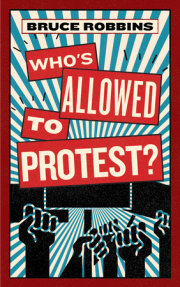
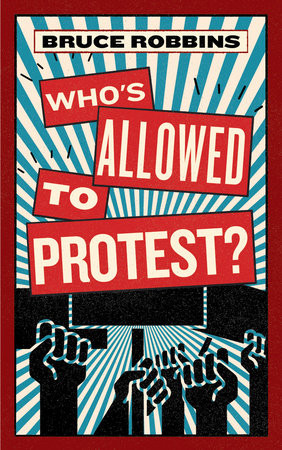
Who's Allowed to Protest?

Author Bruce Robbins On Tour
$18.99 US
Melville House
24 per carton
On sale Feb 24, 2026 | 9781685892579
Sales rights: World

See Additional Formats
WHO’S ALLOWED TO PROTEST? is the essential guide for understanding why some political voices are amplified, others are silenced, and how the fight over “who’s too elite” to dissent will determine our democratic fates.

Why do charges of “privilege” haunt every new protest wave? In this electrifying blend of short history and manifesto, Columbia University professor Bruce Robbins picks apart the insult that demonstrators are merely elite status-seekers—and shows why the same complaints surfaced against Vietnam-era marchers, Iraq War protesters, and, most recently, the Gaza encampments that shook campuses nationwide.

Robbins spars with contemporary critics, like David Brooks and Musa al-Gharbi, who insist that campus activists are secretly angling for elite credentials. Along the way, he recounts his own run-ins with university discipline boards and offers a reckoning with what it really costs—financially, socially, and personally—to stand against abuses of power.
As with Vietnam, the Gaza encampments were protests against American involvement in bodily harm inflicted on people at a considerable distance. But the Gaza protests happened in a period when there was no draft and thus no threat of bodily harm to American protesters except, as it turned out, from campus security and the police. Both cynics and zealous supporters of the Israeli military, who were sometimes the same people, found this appearance of moral generosity galling. In the absence of conscription, they had to cast about for a theory that would highlight the protesters’ self-interest and draw the protest into disrepute. In the case of David Brooks, cynicism fastened itself to their privilege. The protesters, he argued, were only trying to shore up their privileged status as an elite.

You may be quite clear as to what side you’re on about the Gaza protesters. Or you may not. But wherever you stand, there are holes to be filled, confusions to be cleared up. It needs to be said, for example, that Brooks’s anti-elitism has a certain plausibility to the very people he’s accusing. The Gaza protesters at elite schools were often the first to bring up the uncomfortable subject of their unearned advantages. Privilege is something of which they frequently accused themselves. They were obviously not trying to say that their protests should therefore be ignored. Does common sense have any reassurance to offer them? There are perhaps some things that they and future protesters would do well to hear, if only we could figure out what those things are.

Today, anti-elitism nurtures two of the Republican Party’s most cherished projects: its attacks on higher education and its dismantling of federal agencies. Both the universities and the agencies of the federal government stand accused of being staffed by experts who think they know better than ordinary people and, in their arrogance, use their power to propagate woke ideology. David Brooks’s “The Sins of the Educated Class” ends with a menacing prophecy of Donald Trump’s victory in November 2024, a victory that would be achieved, Brooks warned, with significant working-class support and would be followed by a massive attack on the institutions of higher education. This has come to pass. The last sentence of the piece is “The lesson for those of us in the educated class is to seriously reform the system we have created or be prepared to be run over.” As I write, higher education is being run over. The “reforms” the Trump administration has called for higher education to carry out, like handing over potentially incriminating information about student protesters for the purpose of arresting and possibly deporting them and allowing the government to take control over matters of teaching and hiring, could not pass muster with anyone who believes in the independent mission of higher education. But not everyone does. I add that there are other reforms of higher education of which the same could not be said and that might possibly make a dent in Trump’s working-class support.

If sociologist Pierre Bourdieu’s status-conscious cynicism about elites has been getting so much play, and on the right as well as the left, it seems like a good time to stop and ask: What is an elite? Sometimes the word seems to indicate only people who are very good at what they do, like an elite team of firefighters. One might say that if there are such things as unearned privileges, then there are also earned ones; an elite team of firefighters has earned its privileges, such as they are. As have air traffic controllers and financial fraud regulators and many other kinds of specialized workers that society depends on. Bourdieu himself seems less than transparent on this question. Does he think elites, unlike most firefighters, are rich? When he and his followers use the word elite, are they referring to what some of us used to call the ruling class? Is that the implication when student protesters are described as privileged—that these students belong to the group of our society’s ultimate decision-makers? Do they belong, say, with William F. Buckley, who, when readers rolled their eyes at his autobiography, explained, “It simply happens to be the case that I have never in my entire life been without servants, maids, and chauffeurs”? And supposing that student protesters are privileged, in this or some lesser sense of the word, would it follow that their protests don’t have to be taken seriously? Can we assume that radicalism emerging from, say, the middle class—the large swathe of people who are neither rich nor starving—should be ignored as egocentric, ephemeral, or insincere, even when what it’s protesting is, say, military violence?

Before he remade himself at the end of his life as another petition-signing, position-declaiming public intellectual, Pierre Bourdieu took every opportunity to affirm that his work was done within and for the field of sociology. His sociological writing was intended, among other things, to further sociology’s interests. He was assuming, correctly, that as a discipline in competition with other disciplines, sociology has interests. From the outset it has struggled to defend the distinctness of its disciplinary object—society—against, for example, the scholarly imperialism of its powerful neighbor economics, whose disciplinary object, roughly speaking, is money. Economists might ask: Who needs the concept of society to explain anything? They might feel that money, or the desire to maximize one’s wealth, explains the same phenomena that sociology tries to explain, and explains them better. It was partly in order to claim a distinct area of jurisdiction for itself that sociology, as a fledgling discipline, made one of its founding gestures: separating social status from the possession of money—in other words, from class. Class has a tendency to generate two politically polarized sides. Status doesn’t. Status tends to generate a potentially infinite number of subtle gradations. In this or that case, sociology was eager to show, you could have high status in society without being rich. By this gesture, it gave itself jurisdiction over a distinct object that could not be better explained, say, by reference to class or wealth. Separating status from wealth or class, as Max Weber did, is of course what is accomplished again in today’s renewed culture wars by the targeting of status-conscious elites, a targeting which may not be cynical in its tone but is cynical in its substance. You have heard the refrain before: Whatever they may say, elites are only looking out for themselves. “This struggle is not waged on behalf of others”: These words, from The Origins of Postcommunist Elites: From Prague Spring to the Breakup of Czechoslovakia by the sociologist Gil Eyal, crystallize the influence of Bourdieu on the conceptualization of elites as invariably self-interested but, in their claims to represent others, reluctant to admit it.

David Brooks describes his method, which involves mocking the comforts and privileges of student activists and other bourgeois bohemians, as “comic sociology.” Given sociology’s founding logic, it should not be surprising that today’s sociology-inflected discourse of elites, comic or not, is somewhat forgetful about the realities of money. This forgetfulness begs to be corrected. Let us, then, take a few stops along that well-traveled path. Let us try to follow the money.

Following the money is not as straightforward a procedure as it might seem. Philosophically considered, the rough premise should be that there is no such thing as clean money. I’ll spare you examples of the steps—probably not many—that would lead back in any given case from the amassing of supposedly clean money to the eventual source of that money in the dirt of an unjust social system. Dirty money, yes. Clean money, no. In other words, let’s say that all money is dirty. But some money is less dirty than other money. It would seem to follow, therefore, that some money-following methodology must exist that would avoid too much moralizing. As a small step in that direction, we might assume, for starters, that to achieve artistic status without putting aside any money at all is not a viable moral option. Absolute failure to convert your prestige into money might leave you to hang yourself on a freezing Paris street, like Nerval. No one can live on air. Let’s begin by setting the bar low. The desire not to starve ought to be morally uncontroversial.

Evidence of gross and increasing economic inequality in America is easily available and has been for years. The facts and figures are well-known, and yet they are probably still shocking, as they deserve to be. Repeating them here is unnecessary. Given how much worldly evil has been caused by the pursuit of financial self-interest by the managers of hedge funds and private equity funds and billionaires helping elect corrupt, self-dealing politicians, following the money begets the expectation that what will follow can only be an exposé. I have great respect for the exposé genre, but that genre can’t do all the work if you begin by distinguishing, as I do, between having a lot of money and merely having some money—say, enough to live on, or even a bit more than that, enough to feel that you are not one illness or car crash away from financial disaster. That distinction may also seem uncontroversial, but keeping it in mind will help clear away some of the confusion that surrounds words like privilege and elite, words which arguably (so I will argue) get in the way of actual efforts to achieve more equality. Some elites are firefighters. Not all privilege is intolerable.

Paradoxical as it may seem, the main effect of finger-pointing at elites is often to divert attention away from money and from the rich and powerful who benefit most from our political system and have the most control over it. Doug Henwood, one of the few leftist thinkers to examine in serious detail what the left still calls the ruling class, rejects “conceptions of a ruling class that center on PC-obsessed, organic food-eating urban elites.” He goes on, “That set has some influence, especially among the liberal wing of the consciousness industry, but it doesn’t shape the political economy.” It’s the shaping of the political economy, he argues, that ought to be decisive in defining who does and doesn’t belong to the ruling class: “The ruling class consists of a politically engaged capitalist class, operating through lobbying groups. Financial support for politicians, think tanks, and publicity, that meshes with a senior political class that directs the machinery of the state.” To put this another way: The characteristic members of the ruling class are not skilled, educated, credentialed professionals like lawyers, doctors, and consultants. The ruling class is made up of the owners of the firms for which those skilled professionals work. Henwood argues, therefore, against lambasting the “privilege” (he puts the word privilege in quotation marks) of so-called elites. They do not belong to the ruling class as he defines it. Indeed, they may be capable of serving as oppositional thinkers and activists, people ready to cast a cold eye on that ruling class and encourage those who want to do away with it and the economic inequality it depends on: “Growing up bourgeois confers some advantages—time to study, as well as exposure to the nature of power—often denied to people further down the social hierarchy.” It does the cause of equality no good, he implies, if these advantages are treated as incriminating evidence of a privilege that no one should enjoy rather than as signifiers of a well-being that one day will hopefully be available to any and all.

If “privileged” is understood as applicable to anyone who is not desperately needy, the word is leading us astray. It encourages us to measure economic inequality by the wrong yardstick. That is the implicit premise of the Urban Institute’s 2024 report on “The True Cost of Economic Security.” Rather than testifying to “acute need,” the report casts a broader net, looking for those who may be “just getting by” but are not “economically secure.”[i] Economic security stands for what it takes to live sustainably, or, as the report puts it, to thrive. Madeline Leung Coleman underlines the report’s findings for New York City: “Over 60% of New Yorkers do not meet the threshold. Of families with children, it’s 72%.” These figures are more significant than the usual poverty statistics because they take in more of the daily struggle of a large proportion of American households. But they matter for another reason, more relevant here: because they recognize economic security as something other than privilege—that is, as a morally defensible goal. In other words, they recognize the positive value of having some rather than a lot of money. Let us describe this criterion as a quantity of income and savings (more than half of all Americans have no retirement savings at all) that could be mentioned in neighborly gossip without embarrassment. Or as managing well enough.

About

WHO’S ALLOWED TO PROTEST? is the essential guide for understanding why some political voices are amplified, others are silenced, and how the fight over “who’s too elite” to dissent will determine our democratic fates.

Why do charges of “privilege” haunt every new protest wave? In this electrifying blend of short history and manifesto, Columbia University professor Bruce Robbins picks apart the insult that demonstrators are merely elite status-seekers—and shows why the same complaints surfaced against Vietnam-era marchers, Iraq War protesters, and, most recently, the Gaza encampments that shook campuses nationwide.

Robbins spars with contemporary critics, like David Brooks and Musa al-Gharbi, who insist that campus activists are secretly angling for elite credentials. Along the way, he recounts his own run-ins with university discipline boards and offers a reckoning with what it really costs—financially, socially, and personally—to stand against abuses of power.

Excerpt

As with Vietnam, the Gaza encampments were protests against American involvement in bodily harm inflicted on people at a considerable distance. But the Gaza protests happened in a period when there was no draft and thus no threat of bodily harm to American protesters except, as it turned out, from campus security and the police. Both cynics and zealous supporters of the Israeli military, who were sometimes the same people, found this appearance of moral generosity galling. In the absence of conscription, they had to cast about for a theory that would highlight the protesters’ self-interest and draw the protest into disrepute. In the case of David Brooks, cynicism fastened itself to their privilege. The protesters, he argued, were only trying to shore up their privileged status as an elite.

You may be quite clear as to what side you’re on about the Gaza protesters. Or you may not. But wherever you stand, there are holes to be filled, confusions to be cleared up. It needs to be said, for example, that Brooks’s anti-elitism has a certain plausibility to the very people he’s accusing. The Gaza protesters at elite schools were often the first to bring up the uncomfortable subject of their unearned advantages. Privilege is something of which they frequently accused themselves. They were obviously not trying to say that their protests should therefore be ignored. Does common sense have any reassurance to offer them? There are perhaps some things that they and future protesters would do well to hear, if only we could figure out what those things are.

Today, anti-elitism nurtures two of the Republican Party’s most cherished projects: its attacks on higher education and its dismantling of federal agencies. Both the universities and the agencies of the federal government stand accused of being staffed by experts who think they know better than ordinary people and, in their arrogance, use their power to propagate woke ideology. David Brooks’s “The Sins of the Educated Class” ends with a menacing prophecy of Donald Trump’s victory in November 2024, a victory that would be achieved, Brooks warned, with significant working-class support and would be followed by a massive attack on the institutions of higher education. This has come to pass. The last sentence of the piece is “The lesson for those of us in the educated class is to seriously reform the system we have created or be prepared to be run over.” As I write, higher education is being run over. The “reforms” the Trump administration has called for higher education to carry out, like handing over potentially incriminating information about student protesters for the purpose of arresting and possibly deporting them and allowing the government to take control over matters of teaching and hiring, could not pass muster with anyone who believes in the independent mission of higher education. But not everyone does. I add that there are other reforms of higher education of which the same could not be said and that might possibly make a dent in Trump’s working-class support.

If sociologist Pierre Bourdieu’s status-conscious cynicism about elites has been getting so much play, and on the right as well as the left, it seems like a good time to stop and ask: What is an elite? Sometimes the word seems to indicate only people who are very good at what they do, like an elite team of firefighters. One might say that if there are such things as unearned privileges, then there are also earned ones; an elite team of firefighters has earned its privileges, such as they are. As have air traffic controllers and financial fraud regulators and many other kinds of specialized workers that society depends on. Bourdieu himself seems less than transparent on this question. Does he think elites, unlike most firefighters, are rich? When he and his followers use the word elite, are they referring to what some of us used to call the ruling class? Is that the implication when student protesters are described as privileged—that these students belong to the group of our society’s ultimate decision-makers? Do they belong, say, with William F. Buckley, who, when readers rolled their eyes at his autobiography, explained, “It simply happens to be the case that I have never in my entire life been without servants, maids, and chauffeurs”? And supposing that student protesters are privileged, in this or some lesser sense of the word, would it follow that their protests don’t have to be taken seriously? Can we assume that radicalism emerging from, say, the middle class—the large swathe of people who are neither rich nor starving—should be ignored as egocentric, ephemeral, or insincere, even when what it’s protesting is, say, military violence?

Before he remade himself at the end of his life as another petition-signing, position-declaiming public intellectual, Pierre Bourdieu took every opportunity to affirm that his work was done within and for the field of sociology. His sociological writing was intended, among other things, to further sociology’s interests. He was assuming, correctly, that as a discipline in competition with other disciplines, sociology has interests. From the outset it has struggled to defend the distinctness of its disciplinary object—society—against, for example, the scholarly imperialism of its powerful neighbor economics, whose disciplinary object, roughly speaking, is money. Economists might ask: Who needs the concept of society to explain anything? They might feel that money, or the desire to maximize one’s wealth, explains the same phenomena that sociology tries to explain, and explains them better. It was partly in order to claim a distinct area of jurisdiction for itself that sociology, as a fledgling discipline, made one of its founding gestures: separating social status from the possession of money—in other words, from class. Class has a tendency to generate two politically polarized sides. Status doesn’t. Status tends to generate a potentially infinite number of subtle gradations. In this or that case, sociology was eager to show, you could have high status in society without being rich. By this gesture, it gave itself jurisdiction over a distinct object that could not be better explained, say, by reference to class or wealth. Separating status from wealth or class, as Max Weber did, is of course what is accomplished again in today’s renewed culture wars by the targeting of status-conscious elites, a targeting which may not be cynical in its tone but is cynical in its substance. You have heard the refrain before: Whatever they may say, elites are only looking out for themselves. “This struggle is not waged on behalf of others”: These words, from The Origins of Postcommunist Elites: From Prague Spring to the Breakup of Czechoslovakia by the sociologist Gil Eyal, crystallize the influence of Bourdieu on the conceptualization of elites as invariably self-interested but, in their claims to represent others, reluctant to admit it.

David Brooks describes his method, which involves mocking the comforts and privileges of student activists and other bourgeois bohemians, as “comic sociology.” Given sociology’s founding logic, it should not be surprising that today’s sociology-inflected discourse of elites, comic or not, is somewhat forgetful about the realities of money. This forgetfulness begs to be corrected. Let us, then, take a few stops along that well-traveled path. Let us try to follow the money.

Following the money is not as straightforward a procedure as it might seem. Philosophically considered, the rough premise should be that there is no such thing as clean money. I’ll spare you examples of the steps—probably not many—that would lead back in any given case from the amassing of supposedly clean money to the eventual source of that money in the dirt of an unjust social system. Dirty money, yes. Clean money, no. In other words, let’s say that all money is dirty. But some money is less dirty than other money. It would seem to follow, therefore, that some money-following methodology must exist that would avoid too much moralizing. As a small step in that direction, we might assume, for starters, that to achieve artistic status without putting aside any money at all is not a viable moral option. Absolute failure to convert your prestige into money might leave you to hang yourself on a freezing Paris street, like Nerval. No one can live on air. Let’s begin by setting the bar low. The desire not to starve ought to be morally uncontroversial.

Evidence of gross and increasing economic inequality in America is easily available and has been for years. The facts and figures are well-known, and yet they are probably still shocking, as they deserve to be. Repeating them here is unnecessary. Given how much worldly evil has been caused by the pursuit of financial self-interest by the managers of hedge funds and private equity funds and billionaires helping elect corrupt, self-dealing politicians, following the money begets the expectation that what will follow can only be an exposé. I have great respect for the exposé genre, but that genre can’t do all the work if you begin by distinguishing, as I do, between having a lot of money and merely having some money—say, enough to live on, or even a bit more than that, enough to feel that you are not one illness or car crash away from financial disaster. That distinction may also seem uncontroversial, but keeping it in mind will help clear away some of the confusion that surrounds words like privilege and elite, words which arguably (so I will argue) get in the way of actual efforts to achieve more equality. Some elites are firefighters. Not all privilege is intolerable.

Paradoxical as it may seem, the main effect of finger-pointing at elites is often to divert attention away from money and from the rich and powerful who benefit most from our political system and have the most control over it. Doug Henwood, one of the few leftist thinkers to examine in serious detail what the left still calls the ruling class, rejects “conceptions of a ruling class that center on PC-obsessed, organic food-eating urban elites.” He goes on, “That set has some influence, especially among the liberal wing of the consciousness industry, but it doesn’t shape the political economy.” It’s the shaping of the political economy, he argues, that ought to be decisive in defining who does and doesn’t belong to the ruling class: “The ruling class consists of a politically engaged capitalist class, operating through lobbying groups. Financial support for politicians, think tanks, and publicity, that meshes with a senior political class that directs the machinery of the state.” To put this another way: The characteristic members of the ruling class are not skilled, educated, credentialed professionals like lawyers, doctors, and consultants. The ruling class is made up of the owners of the firms for which those skilled professionals work. Henwood argues, therefore, against lambasting the “privilege” (he puts the word privilege in quotation marks) of so-called elites. They do not belong to the ruling class as he defines it. Indeed, they may be capable of serving as oppositional thinkers and activists, people ready to cast a cold eye on that ruling class and encourage those who want to do away with it and the economic inequality it depends on: “Growing up bourgeois confers some advantages—time to study, as well as exposure to the nature of power—often denied to people further down the social hierarchy.” It does the cause of equality no good, he implies, if these advantages are treated as incriminating evidence of a privilege that no one should enjoy rather than as signifiers of a well-being that one day will hopefully be available to any and all.

If “privileged” is understood as applicable to anyone who is not desperately needy, the word is leading us astray. It encourages us to measure economic inequality by the wrong yardstick. That is the implicit premise of the Urban Institute’s 2024 report on “The True Cost of Economic Security.” Rather than testifying to “acute need,” the report casts a broader net, looking for those who may be “just getting by” but are not “economically secure.”[i] Economic security stands for what it takes to live sustainably, or, as the report puts it, to thrive. Madeline Leung Coleman underlines the report’s findings for New York City: “Over 60% of New Yorkers do not meet the threshold. Of families with children, it’s 72%.” These figures are more significant than the usual poverty statistics because they take in more of the daily struggle of a large proportion of American households. But they matter for another reason, more relevant here: because they recognize economic security as something other than privilege—that is, as a morally defensible goal. In other words, they recognize the positive value of having some rather than a lot of money. Let us describe this criterion as a quantity of income and savings (more than half of all Americans have no retirement savings at all) that could be mentioned in neighborly gossip without embarrassment. Or as managing well enough.