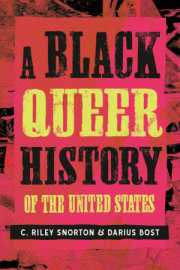
A Black Queer History of the United States

$28.00 US
Beacon Press | Beacon Press Audio
On sale Jan 20, 2026 | 8 Hours and 5 Minutes | 9780807022153
Sales rights: World

See Additional Formats
The first-ever Black history to center queer voices, this landmark study traces the lives of LGBTQ+ Black Americans from slavery to present day

Gender and sexual expression have always been part of the Black freedom struggle


In this latest book in Beacon’s award-winning ReVisioning History series, Professors C. Riley Snorton and Darius Bost unearth the often overlooked history of the Black queer community in the United States.

Arguing that both gender and sexual expression have been an intimate and intricate part of Black freedom struggle, Snorton and Bost present historical contributions of Black queer, trans, and gender non-conforming Americans from slavery to the present day to highlight how the fight against racial injustice has always been linked to that of sexual and gender justice.

Interweaving stories of queer and trans figures such as:
  • Private William Cathay/Cathay Williams, born female but enlisted in the Army as a man in the mid-1860s
  • Josephine Baker, internationally known dancer and entertainer of the early 20th century who was also openly bisexual
  • Bayard Rustin, prominent Civil Rights activist whose well known homosexuality was viewed as a potential threat to the movement
  • Amanda Milan, a black trans woman whose murder in 2000 unified the trans people of color community,

this book includes a deep dive into the marginalization, unjust criminalization, and government legislation of Black queer and trans existence. It also shows how Black Americans have played an integral role in the modern LGBTQ rights movement, countering narratives that have predominantly focused on white Americans.

Through storytelling and other narratives, Snorton and Bost show how the Black queer community has always existed, regardless of the attempts to stamp it out, and how those in it continue to fight for their rightful place in the world.
Authors’ Note

Introduction

PART I: PROOFS OF EXISTENCE

CHAPTER ONE
The Erotic Life of Colonialism and Slavery

CHAPTER TWO
By Any Other Name

CHAPTER THREE
On the Outs

CHAPTER FOUR
Werk!

PART II: WE CANNOT LIVE WITHOUT OUR LIVES

CHAPTER FIVE
Coming Together

CHAPTER SIX
Survival Is Not a Luxury

CONCLUSION
After We’ve Created Our Own History

Notes
Index
Black gay filmmaker, cultural critic, and university professor Marlon Riggs was born in Fort Worth, Texas, in 1954. He received his bachelor of arts degree in history from Harvard University and his master of arts degree in journalism with a specialization in documentary film from the University of California–Berkeley. Riggs wrote, produced, and directed eight films and videos, winning Emmy and Peabody awards for his work. His works explored issues of race, sexuality, and representation in the United States. His later films and videos explored issues of homosexuality and HIV/AIDS amid the culture wars of the 1990s, making him a target of the conservative politicians and the Christian Right. When his film Tongues Untied aired on PBS in 1991, Republican primary candidate Pat Buchanan released an ad targeting his opponent George H. W. Bush using reedited clips from the film. Condemned as pornographic, the film became a talking point on the floor of Congress and among right-wing Christian activists because Riggs received federal funds for its completion.
Riggs’ final film, Black Is . . . Black Ain’t: A Personal Journey Through Black Identity (1994), subverts monolithic notions of blackness. 1 He conducts interviews with prominent community members discussing their diverse upbringings and understandings of the term, shows how regional and group differences produced distinct Black vernaculars and forms of cultural expression, and presents various political and cultural ideologies espoused by Black leaders. Riggs’s emphasis on the diverse meanings and expressions of blackness was deeply personal. It created an opening for him to be included in the Black community as a Black gay man dying of AIDS. African American communities were slow to respond to the AIDS crisis in their communities. The case prevalence increased rapidly among Blacks in the 1980s and ’90s, making them the most affected racial group by 1996. Due to the stigma attached to homosexuality and injection drugs, Black Americans distanced themselves from the community members most affected by the disease. Though African American responses to AIDS changed when the virus began to impact heterosexuals, Black leaders’ and community members’ failure to mobilize around the pandemic early on allowed it to take hold in Black communities. The film was completed posthumously due to Riggs’s death from AIDS, making the disease one driving force in his “personal journey” to define what “Black” is.
While most of the film traces what the term connotes across a range of communities—a phenotype, a political identity, a cultural marker, to name a few meanings—early in the documentary Riggs turns to the dictionary to meditate on what “Black” denotes. He states, “For the longest, of course, being Black wasn’t always beautiful. A sixteenth-century Oxford English Dictionary provides a clue to the word’s meaning before we redefined it.”
He included the following definitions: • Black: deeply stained with dirt; soiled, dirty, foul. • Having dark or deadly purposes, malignant. • Black: pertaining to, or involving death; deadly, baneful, disastrous, sinister. • Iniquitous, atrocious, horrible, wicked. • Black, indicating disgrace, censure, liability to punishment.2 Later in the film, Riggs discussed how African Americans redefined the terms like Black that were used to malign them: “All of those words, when we took them into our own culture, became, I think, affirmations of who we are. Rather than ways which society at large put us down.”3 Riggs referred to the common practice among marginalized groups of reappropriating terms used to marginalize them. Black became a term of political empowerment in the mid-1960s as expressed in the slogan, “Black is beautiful.” In the following scene, Riggs reflected on the AIDS epidemic in the 1990s that demanded Black-identified people to, once again, embrace a word that had been used against them and use it to affirm who they are: AIDS is central to the catalyst that’s pushing me to deal with identity on the global perspective. The connection between AIDS and black folks and black folks’ identity is metaphoric. Both of them are a struggle against the odds in the face of adversity, in the face of possible extinction. How do we keep ourselves together as a people in the face of all of our differences? How do we maintain a sense of communal selfhood, if you will? Who is in the community and who’s not? I mean there has been a history of excluding other black folk from community in this country to the detriment I think of our empowerment as an overall people.4
Riggs recognized that AIDS, that dirty word that pertained to death, was associated with iniquity, which had come to mark Black people with dark and deadly purposes and made them liable to punishment— that AIDS was akin to the word black before it was redefined by the community. Yet, the stigma of AIDS prevented the Black community from affirming the value of those affected and seeing mobilization against the disease as a source of empowerment for the community overall. Riggs had witnessed how Haitian refugees seeking asylum in the US became trapped in Guantanamo Bay prison camps after three hundred of them tested positive for AIDS in the early ’90s. They were not allowed treatment in the US because immigration laws banned HIV-positive people from entering US territory. He saw that in the early 1990s, sub-Saharan Africans made up nine million of the total AIDS cases out of a global total of fourteen million. Million-dollar corporations in the West refused to allow companies in Africa to manufacture the antiretrovirals at costs that would not bankrupt sub-Saharan nations’ already fragile (read: exploited) economies. He saw the difficulties the Black church had dealing with the AIDS crisis because it would force them to rethink the theologies that deemed homosexuality, injection drug use, and nonprocreative sex as immoral. Riggs foresaw how AIDS would reignite US myths of predatory Black male sexuality. In 1997, just two years after the film was released, AIDS would turn the HIV-positive Black man, Nushawn Williams, into a “public health threat.”5 Williams had unprotected sex with numerous young women, nine of whom contracted HIV. His name circulated in mass media despite laws protecting the confidentiality of people with AIDS.
For Riggs, AIDS had, like issues past, unsettled the matter of Black identity and had become another word the community had to embrace and redefine if they were going to continue to beat “the odds in the face of adversity, in the face of possible extinction.”6 Black people’s failure to unify in a moment when Black-identified people faced the possibility of extinction prompted many of the questions that guided Riggs’s personal cinematic journey. Riggs’s exploration of the meaning of Black identity required not only new questions about how to grapple with differences within the community in the present. It also prompted him to look backward toward the “history of excluding other black folk from the community in this country to the detriment . . . of our empowerment as an overall people.”7
In essence, Riggs’s journey to define what “Black is” pushed him to reconsider what Black was. The concerns Riggs’s film raised about the past guide our journey toward A Black Queer History of the United States. We explore the rifts that developed within the community as it sought to rescue Black identity away from its prior meanings. We look for those who were forced to remain in the closet, removed from public-facing roles, or ignored as political constituents in the moments when blackness was being redefined. We search for individuals and groups that became “othered” in the process of developing “a sense of communal selfhood.”8 As with the Black people with AIDS stigmatized in the 1990s, we seek out those whose identities became stained with dirt, soiled, and indicative of disgrace. We view the marginalization of people with AIDS within Black communities as the culmination of neglect of the needs and desires of LGBTQ people throughout the modern Black freedom movement. Our findings show that this neglect was detrimental to the freedom of Black people overall. We begin with this example because the invention of the racial category “Black” as a denigrated caste serves as the foundation of a Black queer history in the United States and as a reason for the illusive nature of this history. In 1619, British settlers captured “20 and odd” Africans from a Portuguese warship and transported them to colonial America to labor as indentured or lifetime servants.9 European settlers’ need for labor propelled further theft and trade of Africans. The transatlantic slave trade homogenized diverse African tribes, evacuating them of their past identities by turning them into commodities. Through a series of laws that made slavery a permanent condition specific to Africans, settlers transformed them into a blackened caste. As a European invention used to justify white settler domination and Black subjugation, blackness became an identity fixed to the bodies of bonded people. This condition of fixity, devaluation, and subjugation served as the historical backdrop to colonial and later US constructions of gender and sexuality. Somehow, Black people found opportunities for gender and sexual exploration in the face of and in resistance to the dominant class that tried to exploit, regulate, and control their bodies. We consider the ellipses in Riggs’s title as referencing the numerous, unnamed possibilities of gender and sexual exploration and liberation that were unrecognized or marginalized as a result of histories of Black racial and sexual domination.
A Black Queer History of the United States provides a more expansive view of blackness in the US that is inclusive of a range of gender expressions and sexual desires, both named and unnamed, including Black queer and trans figures whose lives were recorded in the historical record and those who, by force and/or by choice, remain elusive. This history also names gender and sexual arrangements and practices that may be heterosexual but are considered deviations from white middle-class norms of marriage and family. Pursuing the openings initiated by Riggs, this volume offers a Black queer history of the US that contests dominant historical accounts that assume blackness was and is straight and gender normative. One way to think of blackness in an expansive way, and to consider how it defies any easy categorization, is to play with naming. Whether “Black” is a last name, a drag name, or a reference to icon status, playing with names allows us to speculate about what Black is, was, will be, and ain’t. In the remainder of the introduction, we focus on the narratives of four Black queer and gender-variant people to open this book’s discussion of alternative ways of seeing, framing, and naming a Black queer past.
We begin by examining the career of professional female impersonator Phil Black to redefine Black as genderqueer resistance and to demonstrate how the civil rights of Black queer people were marginalized in mainstream visions of US democracy. Phil Black shows us how the ordinary act of buying shoes can open up considerations of working-class solidarity, the history of anti-cross-dressing laws, and alternatives to civil rights strategies of integration. We then examine the life and death of Black trans woman Georgia Black to demonstrate that histories—what we know and how we talk about the past—create and reflect systems of value. Our historical account of Georgia Black seeks to unsettle those systems that devalue Black queer existence. We look at the larger-than-life figure Joan Jett Blakk, a drag queen who ran for president twice in the 1990s. We show how Black queer performers have used their platform to expose how mainstream US political theater often pays lip service to the causes of marginalized US populations and how spectacular queer performances of blackness might transform mainstream US politics. Finally, we return to Riggs’s film with a focus on Black queer feminist scholar-activist Angela Davis. Her status as a Black historical icon has prevented us from acknowledging her queerness. More than demonstrating an alliance between Black, feminist, and queer thought, Davis’s talking-head interviews make visible the unmarked intersections of Black history, thereby disrupting the gendered and heteronormative assumptions that govern how we see and know the Black past.
“A historical appreciation of queer Black culture and how it shaped American history.”
Kirkus Reviews

“Illuminating . . . [A]n excellent window into a long-repressed past.”
Publishers Weekly

A Black Queer History of the United States isn’t just a book—it’s a balm, a battle cry, and a beautifully subversive remix of the American story. With wit, rigor, and archival elegance, Snorton and Bost have queered the timeline, centering the lives, loves, and legacies of Black LGBTQ+ folks from the colonial past to the chaotic now. They don’t just fill the gaps; they flood them—with kinship, resistance, and receipts.”
—Cheryl Dunye, writer-director, The Watermelon Woman

“Moving through small towns and social movements, A Black Queer History of the United States shows how Black queer and trans life has always been a site of world-building. This book doesn’t ask to be centered, instead it just starts speaking, and everything else rearranges. I needed it. We all do.”
—Tourmaline, author of Marsha: The Joy and Defiance of Marsha P. Johnson

A Black Queer History of the United States explores and collects the untold and told stories of how the most vulnerable people in this nation worked to shape its culture. C. Riley Snorton and Darius Bost can now add their names and this volume to the list of trailblazers, movements, publications, and performances they’ve so skillfully researched for this groundbreaking endeavor. From the colonial-era agitators to contemporary poets, Bost and Snorton know who we are and tell our story, reminding us not only that we’ve always been here but also that we are what’s best about and for America.”
—Jericho Brown, winner of the Pulitzer Prize in Poetry (2002) for The Tradition

About

The first-ever Black history to center queer voices, this landmark study traces the lives of LGBTQ+ Black Americans from slavery to present day

Gender and sexual expression have always been part of the Black freedom struggle


In this latest book in Beacon’s award-winning ReVisioning History series, Professors C. Riley Snorton and Darius Bost unearth the often overlooked history of the Black queer community in the United States.

Arguing that both gender and sexual expression have been an intimate and intricate part of Black freedom struggle, Snorton and Bost present historical contributions of Black queer, trans, and gender non-conforming Americans from slavery to the present day to highlight how the fight against racial injustice has always been linked to that of sexual and gender justice.

Interweaving stories of queer and trans figures such as:
  • Private William Cathay/Cathay Williams, born female but enlisted in the Army as a man in the mid-1860s
  • Josephine Baker, internationally known dancer and entertainer of the early 20th century who was also openly bisexual
  • Bayard Rustin, prominent Civil Rights activist whose well known homosexuality was viewed as a potential threat to the movement
  • Amanda Milan, a black trans woman whose murder in 2000 unified the trans people of color community,

this book includes a deep dive into the marginalization, unjust criminalization, and government legislation of Black queer and trans existence. It also shows how Black Americans have played an integral role in the modern LGBTQ rights movement, countering narratives that have predominantly focused on white Americans.

Through storytelling and other narratives, Snorton and Bost show how the Black queer community has always existed, regardless of the attempts to stamp it out, and how those in it continue to fight for their rightful place in the world.

Table of Contents

Authors’ Note

Introduction

PART I: PROOFS OF EXISTENCE

CHAPTER ONE
The Erotic Life of Colonialism and Slavery

CHAPTER TWO
By Any Other Name

CHAPTER THREE
On the Outs

CHAPTER FOUR
Werk!

PART II: WE CANNOT LIVE WITHOUT OUR LIVES

CHAPTER FIVE
Coming Together

CHAPTER SIX
Survival Is Not a Luxury

CONCLUSION
After We’ve Created Our Own History

Notes
Index

Excerpt

Black gay filmmaker, cultural critic, and university professor Marlon Riggs was born in Fort Worth, Texas, in 1954. He received his bachelor of arts degree in history from Harvard University and his master of arts degree in journalism with a specialization in documentary film from the University of California–Berkeley. Riggs wrote, produced, and directed eight films and videos, winning Emmy and Peabody awards for his work. His works explored issues of race, sexuality, and representation in the United States. His later films and videos explored issues of homosexuality and HIV/AIDS amid the culture wars of the 1990s, making him a target of the conservative politicians and the Christian Right. When his film Tongues Untied aired on PBS in 1991, Republican primary candidate Pat Buchanan released an ad targeting his opponent George H. W. Bush using reedited clips from the film. Condemned as pornographic, the film became a talking point on the floor of Congress and among right-wing Christian activists because Riggs received federal funds for its completion.
Riggs’ final film, Black Is . . . Black Ain’t: A Personal Journey Through Black Identity (1994), subverts monolithic notions of blackness. 1 He conducts interviews with prominent community members discussing their diverse upbringings and understandings of the term, shows how regional and group differences produced distinct Black vernaculars and forms of cultural expression, and presents various political and cultural ideologies espoused by Black leaders. Riggs’s emphasis on the diverse meanings and expressions of blackness was deeply personal. It created an opening for him to be included in the Black community as a Black gay man dying of AIDS. African American communities were slow to respond to the AIDS crisis in their communities. The case prevalence increased rapidly among Blacks in the 1980s and ’90s, making them the most affected racial group by 1996. Due to the stigma attached to homosexuality and injection drugs, Black Americans distanced themselves from the community members most affected by the disease. Though African American responses to AIDS changed when the virus began to impact heterosexuals, Black leaders’ and community members’ failure to mobilize around the pandemic early on allowed it to take hold in Black communities. The film was completed posthumously due to Riggs’s death from AIDS, making the disease one driving force in his “personal journey” to define what “Black” is.
While most of the film traces what the term connotes across a range of communities—a phenotype, a political identity, a cultural marker, to name a few meanings—early in the documentary Riggs turns to the dictionary to meditate on what “Black” denotes. He states, “For the longest, of course, being Black wasn’t always beautiful. A sixteenth-century Oxford English Dictionary provides a clue to the word’s meaning before we redefined it.”
He included the following definitions: • Black: deeply stained with dirt; soiled, dirty, foul. • Having dark or deadly purposes, malignant. • Black: pertaining to, or involving death; deadly, baneful, disastrous, sinister. • Iniquitous, atrocious, horrible, wicked. • Black, indicating disgrace, censure, liability to punishment.2 Later in the film, Riggs discussed how African Americans redefined the terms like Black that were used to malign them: “All of those words, when we took them into our own culture, became, I think, affirmations of who we are. Rather than ways which society at large put us down.”3 Riggs referred to the common practice among marginalized groups of reappropriating terms used to marginalize them. Black became a term of political empowerment in the mid-1960s as expressed in the slogan, “Black is beautiful.” In the following scene, Riggs reflected on the AIDS epidemic in the 1990s that demanded Black-identified people to, once again, embrace a word that had been used against them and use it to affirm who they are: AIDS is central to the catalyst that’s pushing me to deal with identity on the global perspective. The connection between AIDS and black folks and black folks’ identity is metaphoric. Both of them are a struggle against the odds in the face of adversity, in the face of possible extinction. How do we keep ourselves together as a people in the face of all of our differences? How do we maintain a sense of communal selfhood, if you will? Who is in the community and who’s not? I mean there has been a history of excluding other black folk from community in this country to the detriment I think of our empowerment as an overall people.4
Riggs recognized that AIDS, that dirty word that pertained to death, was associated with iniquity, which had come to mark Black people with dark and deadly purposes and made them liable to punishment— that AIDS was akin to the word black before it was redefined by the community. Yet, the stigma of AIDS prevented the Black community from affirming the value of those affected and seeing mobilization against the disease as a source of empowerment for the community overall. Riggs had witnessed how Haitian refugees seeking asylum in the US became trapped in Guantanamo Bay prison camps after three hundred of them tested positive for AIDS in the early ’90s. They were not allowed treatment in the US because immigration laws banned HIV-positive people from entering US territory. He saw that in the early 1990s, sub-Saharan Africans made up nine million of the total AIDS cases out of a global total of fourteen million. Million-dollar corporations in the West refused to allow companies in Africa to manufacture the antiretrovirals at costs that would not bankrupt sub-Saharan nations’ already fragile (read: exploited) economies. He saw the difficulties the Black church had dealing with the AIDS crisis because it would force them to rethink the theologies that deemed homosexuality, injection drug use, and nonprocreative sex as immoral. Riggs foresaw how AIDS would reignite US myths of predatory Black male sexuality. In 1997, just two years after the film was released, AIDS would turn the HIV-positive Black man, Nushawn Williams, into a “public health threat.”5 Williams had unprotected sex with numerous young women, nine of whom contracted HIV. His name circulated in mass media despite laws protecting the confidentiality of people with AIDS.
For Riggs, AIDS had, like issues past, unsettled the matter of Black identity and had become another word the community had to embrace and redefine if they were going to continue to beat “the odds in the face of adversity, in the face of possible extinction.”6 Black people’s failure to unify in a moment when Black-identified people faced the possibility of extinction prompted many of the questions that guided Riggs’s personal cinematic journey. Riggs’s exploration of the meaning of Black identity required not only new questions about how to grapple with differences within the community in the present. It also prompted him to look backward toward the “history of excluding other black folk from the community in this country to the detriment . . . of our empowerment as an overall people.”7
In essence, Riggs’s journey to define what “Black is” pushed him to reconsider what Black was. The concerns Riggs’s film raised about the past guide our journey toward A Black Queer History of the United States. We explore the rifts that developed within the community as it sought to rescue Black identity away from its prior meanings. We look for those who were forced to remain in the closet, removed from public-facing roles, or ignored as political constituents in the moments when blackness was being redefined. We search for individuals and groups that became “othered” in the process of developing “a sense of communal selfhood.”8 As with the Black people with AIDS stigmatized in the 1990s, we seek out those whose identities became stained with dirt, soiled, and indicative of disgrace. We view the marginalization of people with AIDS within Black communities as the culmination of neglect of the needs and desires of LGBTQ people throughout the modern Black freedom movement. Our findings show that this neglect was detrimental to the freedom of Black people overall. We begin with this example because the invention of the racial category “Black” as a denigrated caste serves as the foundation of a Black queer history in the United States and as a reason for the illusive nature of this history. In 1619, British settlers captured “20 and odd” Africans from a Portuguese warship and transported them to colonial America to labor as indentured or lifetime servants.9 European settlers’ need for labor propelled further theft and trade of Africans. The transatlantic slave trade homogenized diverse African tribes, evacuating them of their past identities by turning them into commodities. Through a series of laws that made slavery a permanent condition specific to Africans, settlers transformed them into a blackened caste. As a European invention used to justify white settler domination and Black subjugation, blackness became an identity fixed to the bodies of bonded people. This condition of fixity, devaluation, and subjugation served as the historical backdrop to colonial and later US constructions of gender and sexuality. Somehow, Black people found opportunities for gender and sexual exploration in the face of and in resistance to the dominant class that tried to exploit, regulate, and control their bodies. We consider the ellipses in Riggs’s title as referencing the numerous, unnamed possibilities of gender and sexual exploration and liberation that were unrecognized or marginalized as a result of histories of Black racial and sexual domination.
A Black Queer History of the United States provides a more expansive view of blackness in the US that is inclusive of a range of gender expressions and sexual desires, both named and unnamed, including Black queer and trans figures whose lives were recorded in the historical record and those who, by force and/or by choice, remain elusive. This history also names gender and sexual arrangements and practices that may be heterosexual but are considered deviations from white middle-class norms of marriage and family. Pursuing the openings initiated by Riggs, this volume offers a Black queer history of the US that contests dominant historical accounts that assume blackness was and is straight and gender normative. One way to think of blackness in an expansive way, and to consider how it defies any easy categorization, is to play with naming. Whether “Black” is a last name, a drag name, or a reference to icon status, playing with names allows us to speculate about what Black is, was, will be, and ain’t. In the remainder of the introduction, we focus on the narratives of four Black queer and gender-variant people to open this book’s discussion of alternative ways of seeing, framing, and naming a Black queer past.
We begin by examining the career of professional female impersonator Phil Black to redefine Black as genderqueer resistance and to demonstrate how the civil rights of Black queer people were marginalized in mainstream visions of US democracy. Phil Black shows us how the ordinary act of buying shoes can open up considerations of working-class solidarity, the history of anti-cross-dressing laws, and alternatives to civil rights strategies of integration. We then examine the life and death of Black trans woman Georgia Black to demonstrate that histories—what we know and how we talk about the past—create and reflect systems of value. Our historical account of Georgia Black seeks to unsettle those systems that devalue Black queer existence. We look at the larger-than-life figure Joan Jett Blakk, a drag queen who ran for president twice in the 1990s. We show how Black queer performers have used their platform to expose how mainstream US political theater often pays lip service to the causes of marginalized US populations and how spectacular queer performances of blackness might transform mainstream US politics. Finally, we return to Riggs’s film with a focus on Black queer feminist scholar-activist Angela Davis. Her status as a Black historical icon has prevented us from acknowledging her queerness. More than demonstrating an alliance between Black, feminist, and queer thought, Davis’s talking-head interviews make visible the unmarked intersections of Black history, thereby disrupting the gendered and heteronormative assumptions that govern how we see and know the Black past.

Praise

“A historical appreciation of queer Black culture and how it shaped American history.”
Kirkus Reviews

“Illuminating . . . [A]n excellent window into a long-repressed past.”
Publishers Weekly

A Black Queer History of the United States isn’t just a book—it’s a balm, a battle cry, and a beautifully subversive remix of the American story. With wit, rigor, and archival elegance, Snorton and Bost have queered the timeline, centering the lives, loves, and legacies of Black LGBTQ+ folks from the colonial past to the chaotic now. They don’t just fill the gaps; they flood them—with kinship, resistance, and receipts.”
—Cheryl Dunye, writer-director, The Watermelon Woman

“Moving through small towns and social movements, A Black Queer History of the United States shows how Black queer and trans life has always been a site of world-building. This book doesn’t ask to be centered, instead it just starts speaking, and everything else rearranges. I needed it. We all do.”
—Tourmaline, author of Marsha: The Joy and Defiance of Marsha P. Johnson

A Black Queer History of the United States explores and collects the untold and told stories of how the most vulnerable people in this nation worked to shape its culture. C. Riley Snorton and Darius Bost can now add their names and this volume to the list of trailblazers, movements, publications, and performances they’ve so skillfully researched for this groundbreaking endeavor. From the colonial-era agitators to contemporary poets, Bost and Snorton know who we are and tell our story, reminding us not only that we’ve always been here but also that we are what’s best about and for America.”
—Jericho Brown, winner of the Pulitzer Prize in Poetry (2002) for The Tradition