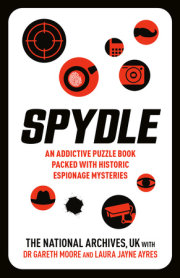
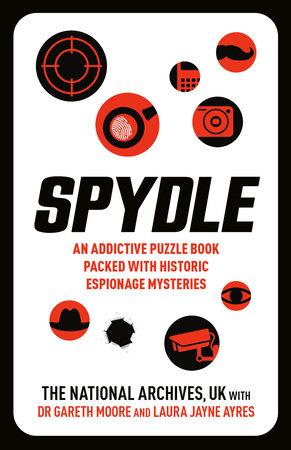
Spydle

An Addictive Puzzle Book Packed with Historic Espionage Mysteries

Look inside
Paperback
$16.99 US
Clarkson Potter/Ten Speed | Ten Speed Press
24 per carton
On sale Nov 26, 2024 | 9780593837702
Sales rights: US,CAN,OpnMkt(no EU)

See Additional Formats
Decode messages, untangle clues, and test your logic with 134 addictive and exciting Murdle-style puzzles based on 500 years of British espionage history, from Britain's preeminent puzzle master with the support of The National Archives, UK.

Britain's leading puzzle master, Dr. Gareth Moore, has plumbed the depths of the UK's National Archives to transform the best in espionage history into 134 thrilling puzzles that you can solve from the comfort of your couch. Decipher encoded messages to stop treason in its tracks, assemble clues to intercept dangerous missives, and put your logic to the test as you uncover enemy locations and support rescue missions. 

Spydle puts you right into the center of the action with tales of espionage and intrigue from Thomas Cromwell's spy network to Guy Fawkes, Mata Hari, the Enigma machine, and more. With puzzles across an array of difficulty levels, alongside photographs of the real papers, cyphers, and spies from throughout British history, Spydle is a must-have activity book for the spy, sleuth, and mystery lover in all of us.
Introduction


The words ‘secret intelligence’ and ‘espionage’ often bring to mind the shadowy world of Cold War intrigue inhabited by James Bond in the Ian Fleming novels. The fictional British Secret Service agent is aided in his daring exploits by gadgets supplied by Q Branch, such as the infamous booby-trapped attaché case. This incredible device was, in fact, a real invention from the Second World War and was primed to explode when the lid was opened. Fleming himself worked in British naval intelligence and conceived Operation Goldeneye, a wartime plan to spy on General Franco’s Spain, so it is unsurprising that his wartime experiences gave inspiration to his novels.

The stories unearthed at The National Archives and featured in this book span five hundred years of spying, from Henry VIII to the Cold War. They include the Gunpowder Plot to blow up Parliament in 1605, which was foiled thanks to a piece of lastminute intelligence. The threat of foreign invasion was kept at bay, traitors apprehended, diplomacy conducted and wars fought—all with the aid of spies.

What these stories show is that the motives and methods of spying are surprisingly enduring. The need to understand an adversary’s capability can be seen both in the intelligence on the Spanish Armada, sent to invade Elizabeth I’s England in 1588, but also in the monitoring of Soviet military deployments in East Germany in the 1980s. Ciphers were used by Mary, Queen of Scots, to encrypt her letters in a treasonous plot in 1586 to supplant Elizabeth I. Hundreds of years later, the cracking of the German Enigma codes—used to encrypt military communications—would prove vital to Allied victory in the Second World War. Invisible ink was as useful a tool in the First World War as it had been during the Gunpowder Plot.

The true story of espionage is as extraordinary as fiction, and it begins hundreds of years ago . . .

About

Decode messages, untangle clues, and test your logic with 134 addictive and exciting Murdle-style puzzles based on 500 years of British espionage history, from Britain's preeminent puzzle master with the support of The National Archives, UK.

Britain's leading puzzle master, Dr. Gareth Moore, has plumbed the depths of the UK's National Archives to transform the best in espionage history into 134 thrilling puzzles that you can solve from the comfort of your couch. Decipher encoded messages to stop treason in its tracks, assemble clues to intercept dangerous missives, and put your logic to the test as you uncover enemy locations and support rescue missions. 

Spydle puts you right into the center of the action with tales of espionage and intrigue from Thomas Cromwell's spy network to Guy Fawkes, Mata Hari, the Enigma machine, and more. With puzzles across an array of difficulty levels, alongside photographs of the real papers, cyphers, and spies from throughout British history, Spydle is a must-have activity book for the spy, sleuth, and mystery lover in all of us.

Excerpt

Introduction


The words ‘secret intelligence’ and ‘espionage’ often bring to mind the shadowy world of Cold War intrigue inhabited by James Bond in the Ian Fleming novels. The fictional British Secret Service agent is aided in his daring exploits by gadgets supplied by Q Branch, such as the infamous booby-trapped attaché case. This incredible device was, in fact, a real invention from the Second World War and was primed to explode when the lid was opened. Fleming himself worked in British naval intelligence and conceived Operation Goldeneye, a wartime plan to spy on General Franco’s Spain, so it is unsurprising that his wartime experiences gave inspiration to his novels.

The stories unearthed at The National Archives and featured in this book span five hundred years of spying, from Henry VIII to the Cold War. They include the Gunpowder Plot to blow up Parliament in 1605, which was foiled thanks to a piece of lastminute intelligence. The threat of foreign invasion was kept at bay, traitors apprehended, diplomacy conducted and wars fought—all with the aid of spies.

What these stories show is that the motives and methods of spying are surprisingly enduring. The need to understand an adversary’s capability can be seen both in the intelligence on the Spanish Armada, sent to invade Elizabeth I’s England in 1588, but also in the monitoring of Soviet military deployments in East Germany in the 1980s. Ciphers were used by Mary, Queen of Scots, to encrypt her letters in a treasonous plot in 1586 to supplant Elizabeth I. Hundreds of years later, the cracking of the German Enigma codes—used to encrypt military communications—would prove vital to Allied victory in the Second World War. Invisible ink was as useful a tool in the First World War as it had been during the Gunpowder Plot.

The true story of espionage is as extraordinary as fiction, and it begins hundreds of years ago . . .