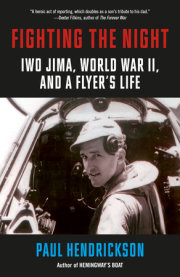
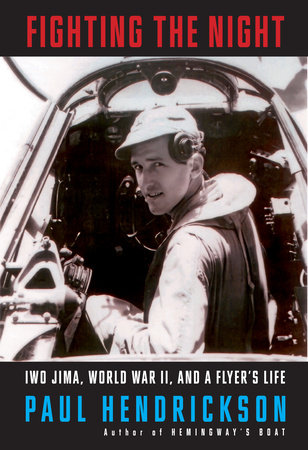
Fighting the Night

Iwo Jima, World War II, and a Flyer's Life

Ebook (EPUB)
$12.99 US
Knopf | Vintage
On sale May 07, 2024 | 9780593321140
Sales rights: World

See Additional Formats
From the acclaimed and best-selling author of Hemingway’s Boat, the profoundly moving story of his father’s wartime service as a night fighter pilot, and the prices he and his fellow soldiers paid for their acts of selfless, patriotic sacrifice

In the fall of 1944, Joe Paul Hendrickson, the author’s father, kissed his twenty-one-year-old wife and two baby children goodbye. The twenty-five-year-old first lieutenant, pilot of a famed P-61 Black Widow, was leaving for the war. He and his night fighter squadron were sent to Iwo Jima, where, for the last five and a half months of World War II, he flew approximately seventy-five missions, largely in pitch-black conditions. His wife would wait out the war at the home of her small-town Ohio parents, one of the countless numbers of American family members shouldering the burden of being left behind.

Joe Paul, the son of a Depression-poor Kentucky sharecropper, was fresh out of high school in 1937 when he enlisted in mechanic school in the peacetime Army Air Corps. Eventually, he was able to qualify for flight school. After marriage, and with the war on, the young officer and his bride crisscrossed the country, airfield to airfield, base to base: Santa Ana, Yuma, Kissimmee, Bakersfield, Orlando, La Junta, Fresno. He volunteered for night fighters and the newly arrived and almost mythic Black Widow. A world away, the carnage continued. As Paul Hendrickson tracks his parents’ journey, together and separate, both stateside and overseas, he creates a vivid portrait of a hard-to-know father whose time in the war, he comes to understand, was something truly heroic, but never without its hidden and unhidden psychic costs.

Bringing to life an iconic moment of American history, and the tragedy of all wars, Fighting the Night is an intense and powerful story of violence and love, forgiveness and loss. And it is a tribute to those who got plunged into service, in the best years of their lives, and the sacrifices they and their loved ones made, then and thereafter.
CAUTION: This email originated from outside of Penguin Random House. Please be extra cautious when opening file attachments or clicking on links.

Part One

Beginnings

Sundays too my father got up early

and put his clothes on in the blueblack cold,

then with cracked hands that ached

from labor in the weekday weather made

banked fires blaze. No one ever thanked him.

—Robert Hayden, “Those Winter Sundays”

It’s one of the things that moves me most about his life—the leap my father seemed to make through time and space from a Depression farm boy sitting on wagon tongues in baking Kentucky hayfields, dreaming of airplanes, to someone who, not even two decades later, was piloting airliners out of what was commonly called, when we were kids growing up ourselves, “The World’s Busiest Airport.”

The title of world’s busiest belonged first to Midway on the southwest side of Chicago, when, as I’ve already noted, my dad had started out, after the war, in mid-1946, for $225 a month as a copilot for Eastern Air Lines in those old workhorse and tail-dragging DC-3s. And then, in the late fifties and early sixties, when the high-whined turboprops and first generation of jets came in, the title got passed to O’Hare International on the northwest side of the city. We’d moved up closer to the city by then. He’d made captain by then. I think my father flew something like ten different aircraft for Eastern, from the prop age to the jet age, from Martin 404s to DC-7s to Lockheed Electras to Super Connies to the 727 Whisperjet, before his thirty-year commercial aviation career was over. Before he couldn’t pass the company physicals anymore because of his weakening heart. And for almost all of that time, he worked out of either Midway or O’Hare as his home base.

Which, somehow, he always referred to as “the field.” They were all fields to him, whether a weedy single strip of macadam or some vast complex of crosshatched runways. That was his Kentucky past calling. The taking-off place and the landing place was the field. I remember him saying that when we were small, my older brother, Marty, and my younger brother Ric and I, lining up to tell him goodbye as he was leaving on a “trip” (all he ever called it) with a two- or three-night layover—maybe down to Miami, with plenty of stops along the way, and then working back through some of those same stops, maybe Atlanta, Charlotte, Raleigh-Durham, Charley West (what he always called Charleston, West Virginia), Louisville, Indianapolis, home.

As I wrote elsewhere: “Sometimes he had to leave in the middle of the night, and then I would hear him moving at the front of the house, talking to my mother, his voice waving through my sleep as though through water. Other times he left after supper, or on Sunday after church, or before Marty and I got home from school.”

Say the leaving was in the daytime, after school, late afternoon, just when other fifties fathers might have been arriving home from work. Out in the driveway, with our family’s green Oldsmobile 88 idling beside him, he’d be in his captain’s hat, with the beautiful medallion of a red falcon on the brim, and the scrambled egg on the visor, and in his starched dress shirt with the epaulets on the shoulders, and in his dark blue woolen uniform with the gold buttons on the jacket and the raised gold stripes on the sleeve. He smelled of talc and Old Spice. He’d be holding his thick and beat-up old black leather satchel case stuffed with manuals—his “brain bag,” he called it. He’d set it in the trunk, along with his metallic silver suitcase. The emperor of the air was going off. Which often enough was an incredible relief. It was as if the house—our lives—could slump again. The fact that he was going away for the next two or three days created in me a queer feeling of both loneliness and euphoria. This was the two-edged sword we lived by: terrified something bad might happen to him on a winter night up there in the high and the mighty, and the simultaneous joy of being free for the moment of his often explosive and arbitrary-seeming temper. Two-edged because of course we loved him, craved his approvals. Two-edged because of course there were plenty of times when he seemed the best dad in the world.

“Well, honey, I’d better head for the field,” he’d say. He and my mom would kiss goodbye. Marty and Ric and I would shake his strong hand. I don’t remember ever once trying to kiss him. It was impossible to do that. Sometimes there might be a semi-hug.

That other kind of field: I remember him telling me not too long before he died, when I was more overtly trying to get him to speak about flying and the past, and specifically about Kentucky, of how he was once sitting on the tongue of a wagon in a sweltering Union County hayfield when overhead came this terrible roar, and then this huge shadow darkening the earth all around him. His voice grew soft, as if recounting a gauzy dream.

“It was a Ford Trimotor, Paul. It was silver. It flew right over top of me. I was out there all alone. I would have gotten the strap for sitting on that tongue instead of working. I heard it coming before I could see it. It came over the rise. It seemed about a hundred feet over my head, as if it was going to land and pick me up, or maybe drop a ladder down. I could make out the pilot in the little window on the side of the fuselage under the wing. Must have been about ’32. I was fourteen or fifteen. It went right on past me, the noise just huge. I was trembling. It landed in a big pasture on the other side of Morganfield. The next day the people who owned it, and who were barnstorming it through the countryside, along with a biplane that was doing acrobatics, started taking people up for a dollar a ride. I got a ride. I have no idea where I got that dollar. A dollar? Who had a dollar? After, when I told my folks I was someday going to fly airplanes, my mother said, ‘Joe Paul, if you want to commit suicide, why don’t you just go out there and jump off the barn?’ ”

My dad wasn’t Wiley Post or Lindbergh, but it was his own kind of leap, and he made it. None of it would have happened without World War II. But it’s also true that the leap could not have been made without my father’s force of will, his certainty in self. None of his other siblings ever possessed this quality of character to the extent he did. Why the third-born in a sharecropping family of nine kids in far rural and unelectrified western Kentucky should have had such vision and vaulting ambition is something I won’t try to answer here. It was just in him. I doubt he ever quite understood it himself. To reference the beautiful Robert Penn Warren poem at the start of this book: Something was happening in a boy’s heart. He didn’t know what it was. Those great geese in the moonless thirties night were honking him northward, away from Union County, even if there is a whole other sense, or so I believe, in which my father never left Morganfield and Union County at all.

Long Ago in Kentucky

Such a serious gaze, almost unnerving. I can’t say it’s untypical. In his baggy and high-waisted dungarees turned up at the cuff. In his coarse-looking work shirt, which must have been rubbed so many times across the washboard by my grandmother that the coarseness of the cloth, with its glints of bluing in it, may actually have felt soft as lanolin against his skin. With his fist held tight on that bridle, right at the edge of the bit, showing the horse who’s boss. With the slightest stoop to his shoulders that I remember so well the entire time I knew him. My father told me once that he felt self-conscious when he went into the service because he seemed taller than everyone else around him. But at his tallest, he was only six-foot-one, and he doesn’t look quite grown out to that here. “I’d’ve been handsome if I ever stood up straight,” he used to say.

Yes, serious-looking, and with that pencil of cig that’s probably a roll-your-own and that he’s holding so naturally between index and middle finger. I remember him holding his smokes like that, down low, against his trouser leg, with his slightly raised thumb poised to flick off the ash reflexively. My dad smoked them one after the other when we grew up—unfiltered Camels and Chesterfields and Luckies. Then he went to menthols with filters. Long into my adolescence, he was still a four-pack-a-day man. And then, speaking of force of will: One day, right in the middle of a Kool or Salem or whatever it was (at least this is our family legend), he threw the cigarette down out in the yard and crushed it and cursed it and walked away and never touched one again. And, of course, once he’d quit, he became a zealot against them, eager to show his contempt for weak people addicted to nicotine.

How old would he be in this photo? I’d guess about seventeen or eighteen, in which case it’s about 1935 or 1936, and he’s either a junior or a senior at Morganfield High School. They’re living out on the Will Tom Wathen farm, cropping on the share again, because the bankers have foreclosed on the family again. “I remember when they foreclosed on Daddy,” my father once told me. “Back then, when you lost the farm, they took everything—we had our clothes and a team of horses. They even took the furniture.”

Such an odd and on the other hand entirely understandable way to say it: “losing” the farm, as if you’ve inadvertently dropped something out of your back pocket. When what you’re really trying to acknowledge in the least humiliating way possible is your shame. It wasn’t as if you didn’t try. You just couldn’t make the payments. You and your wife had too many mouths to feed. It wasn’t your fault. Maybe you couldn’t even make the $148.33 of yearly taxes due on your land to satisfy the state, the county, the school board, and the road commission. Never mind payments to the bank or other title holder for the property itself. And then one day there was your name on page seven in the weekly Union County Advocate under the one-column headline: “SHERIFF’S SALE FOR TAXES.” At the courthouse door next Monday, between the hours of 11 and 3, the sheriff or his deputy intend to sell you out, auction off all you have, or at least preside over the selling off, and this is the official published notice of it to all your neighbors (some of whose names are also on the list). Because you don’t have $148.33.

This kind of indignity is interwoven into the history of my extended family’s farming roots in Kentucky. Those roots go back in Union County into the nineteenth century, and in other parts of the state they predate the American Revolution. The roots are about family and hard work.

What I have just described literally happened to my great-grandfather in 1932 and 1933—he couldn’t make the bundled state/county/school/road taxes on his 205 acres, about four miles out of town, off the Crawley Road. His name was Philip Kincheloe Hendrickson, and he seems often to have gone by “P.K.” or “Kinch.” (The name has variant spellings; it’s pronounced KINCH-low.) In his pictures, he looks like somebody out of the James Gang, or maybe one of Cole Younger’s boys. I never knew him, but I knew his son, George Hendrickson, my dad’s dad, my grandpa, and, in fact, I knew him very well. I was almost nineteen when he died. I was in the seminary, and the priests let me come to Kentucky in that frozen February of 1963 for Grandpa Hendrickson’s funeral. Something shocking happened at the reading of the will in the parlor after the burial, with everyone assembled: My dad and all the others who had moved off the farm to make their way in the world got disinherited. My dad left town in a rage. He swore he was going to contest the will in court. He never entirely got over it. It wasn’t the money.

About six generations of Hendricksons have broken Union County soil, are still breaking it. That includes two of my first cousins, Jimbo and Keith, and their own sons, men now in their thirties and forties. They don’t do it with two mules and a plow and a mouthful of dirt. They ride in air-conditioned cabs with leather seats and built-in stereos atop monster pieces of machinery that can plant twenty-four rows of corn seed in a single swath and for which they are paying on time—the multi-hundred-thousand-dollar machines, that is. Along with payments on the land.

Yes, Hendricksons have broken the soil, and often enough the soil has broken them. It’s much truer for some of those earlier generations than the latter, although in another way it’s still the old story: You do the work, and the bankers hold all the money cards, or seem to. It was the evil New York Life Insurance Company that dispossessed Kincheloe Hendrickson in 1932. He had been a farmer for half a century in Union County, and they took it all away from him when he was nearly seventy-three. He moved to Louisville. After he died, in 1946, the family brought him back for burial in Union County, and his small stone is there now, one side of it popping up out of the earth, as if in protest of what was done by faceless people in suits in faraway cities.

You don’t have to go back three or four or five Hendrickson generations in Union County to sense how hard it was. The family my father grew up in got foreclosed at least once in the mid- to late twenties, and then again, a few years later, before they went back to farming on the share. My dad’s family sharecropped through most of the thirties, until he left home for the service. Actually, it’s a sadder story than that: Kincheloe had put up his own farm as collateral in September 1931 to try to help save my grandfather’s farm—and both father and son, Kincheloe and George, ended up losing what they had. There was a great bitterness and a family falling-out.

Eventually, it healed.

The place of my father’s birth sits on the western edge of what some Union Countians still refer to as the Great Western Coal Field. It’s tucked into a semi-hidden and hard-to-get-to crook of the state, west of Owensboro, southwest of Evansville, Indiana, across the river from Shawneetown, Illinois, not really close to anything you’d describe as urban. Even now, with America having long since shrunk itself down in driving and flying times with superhighways and big metropolitan airports, you’d still have to want to get to tiny Morganfield and sparsely populated Union County.
“Here is another magnificent work of non-fiction literature from the master craftsman Paul Hendrickson. Like the others, this book is scrupulously honest, deeply felt and beautifully written. But now he turns his art to a timeless subject: a son’s quest to know—really know—his father.”​ —David Von Drehle, author of The Book of Charlie

"A beautifully written exploration of [the author's] father’s World War II service as the pilot of a P-61 Black Widow night fighter... Paul Hendrickson...is a probing journalist who prioritizes facts over sensationalism...[in this] absorbing narrative.... Mr. Hendrickson spoke with a dizzying array of family members and friends... [and though] he never met the only enlisted man on the three-man crew... his research... is so evocative and perceptive that one might think the author knew him intimately.... The book is a journey into discovery.... a fascinating immersion in the melancholy yet somehow uplifting tale of one American family... One comes away...highly impressed." —John C. McManus, The Wall Street Journal

"Fighting the Night
is a riveting tale about World War II military aviation. The book also movingly—and unsparingly—documents Hendrickson’s relationship with his sometimes-distant father."—Air & Space

"[A book] to brighten the rest of the season.... [Paul] Hendrickson, a former Washington Post staff writer, has written acclaimed books about Ernest Hemingway and Robert McNamara.... In his latest, he turns to the subject of his own family." —The Washington Post

"This thoroughly engrossing story is a miracle in oh so many ways."—Dayton Daily News

“In Fighting the Night, Paul Hendrickson has managed to revive the vanished world of his father, whose formative moment came long ago, when he flew a fighter plane over the Pacific. This is a heroic act of reporting, which doubles as a son's tribute to his dad.” —Dexter Filkins, author of The Forever War

"With deep vision, Paul Hendrickson narrates his search for what his Dad and his combat buddies experienced in the Pacific. It is beautifully reported and written, like all of Paul’s work. What makes this book special is that it’s a much larger journey into the collective psyche of the members of the Baby Boom generation who have lived in the light and shadow of their parents’ experiences in combat long ago."—David Ignatius, columnist, The Washington Post

“Paul Hendrickson has long stood apart from other writers because of his singular, lyrical voice, and Fighting the Night is the work of a great author at his very best. The themes have universal appeal — fathers and sons, love and war — but the true heart of Fighting the Night is Hendrickson’s reckoning with the ghosts of a life in a book that is hypnotic, profound, achingly honest and compulsively readable." —David Finkel, author of Thank You for Your Service

Fighting the Night is beautiful, searing, and poignant, an investigation of the human heart, of sky, and of father and son, prewar and postwar. I thought it might be another WWII book, and while there’s war, sure enough, it’s what happens in the hearts of men (and mothers on the home front) that distinguishes this book. Paul Hendrickson was walking toward the batter’s box through all his books, leading up to this moment. And when it came time to finally lay this one down, he swung with the fierceness of a Babe Ruth. It takes a certain kind of mountain climbing to write a book like this. Readers are going to be mighty grateful.”—Wil Haygood, author of Colorization

“There are countless books about World War II, the war in the Pacific, and the fight for Iwo Jima. Paul Hendrickson’s Fighting the Night is unique — a son telling the story of his father’s experiences as a combat pilot in the aftermath of the Iwo Jima campaign but written with extraordinary intimacy about how he got there, what he did there, and the impact it had on the rest of his life and on his family. It is a story of friendships forged, the emotional scars, and just coping after the war. Fighting the Night is more, though. It is the story of every war, every man in combat, and the scars each man — and his family — bears. It is a beautiful book, a stark and raw one in many ways, and a magnificent tribute to the author's father.”—Robert M. Gates, Secretary of Defense 2006-2011

"Tender, heartwarming, occasionally frightening, and written in a conversational style that invites the reader into his family, Hendrickson pilots this richly illuminating chronicle across Depression-era Kentucky farmlands to flight school and through his father's deployment in the Pacific and his postwar career as a pilot for Eastern Airlines... An excellent, engrossing work of family and world history that leaves readers thinking in new ways about the consequences of military service."—James Pekoll, Booklist

"Biographer Hendrickson (Plagued by Fire) offers an intimate exploration of the life and military career of his father, U.S. Army Air Corps pilot Joe Hendrickson (1918–2003)... Coupling a poignant personal journey with propulsive aviation action, this WWII history flies high."Publishers Weekly

"Detailing the challenges of a young military family, Joe Paul's dangerous wartime missions, and the lingering effects of war, Hendrickson poignantly examines a life and a historic time."Library Journal

"[A] detailed, vivid narrative, which benefits from intensive archival research and exhaustive interviews...An expert account of a father’s WWII experiences that gives his fellow airmen equal attention."Kirkus Reviews

About

From the acclaimed and best-selling author of Hemingway’s Boat, the profoundly moving story of his father’s wartime service as a night fighter pilot, and the prices he and his fellow soldiers paid for their acts of selfless, patriotic sacrifice

In the fall of 1944, Joe Paul Hendrickson, the author’s father, kissed his twenty-one-year-old wife and two baby children goodbye. The twenty-five-year-old first lieutenant, pilot of a famed P-61 Black Widow, was leaving for the war. He and his night fighter squadron were sent to Iwo Jima, where, for the last five and a half months of World War II, he flew approximately seventy-five missions, largely in pitch-black conditions. His wife would wait out the war at the home of her small-town Ohio parents, one of the countless numbers of American family members shouldering the burden of being left behind.

Joe Paul, the son of a Depression-poor Kentucky sharecropper, was fresh out of high school in 1937 when he enlisted in mechanic school in the peacetime Army Air Corps. Eventually, he was able to qualify for flight school. After marriage, and with the war on, the young officer and his bride crisscrossed the country, airfield to airfield, base to base: Santa Ana, Yuma, Kissimmee, Bakersfield, Orlando, La Junta, Fresno. He volunteered for night fighters and the newly arrived and almost mythic Black Widow. A world away, the carnage continued. As Paul Hendrickson tracks his parents’ journey, together and separate, both stateside and overseas, he creates a vivid portrait of a hard-to-know father whose time in the war, he comes to understand, was something truly heroic, but never without its hidden and unhidden psychic costs.

Bringing to life an iconic moment of American history, and the tragedy of all wars, Fighting the Night is an intense and powerful story of violence and love, forgiveness and loss. And it is a tribute to those who got plunged into service, in the best years of their lives, and the sacrifices they and their loved ones made, then and thereafter.

Excerpt

CAUTION: This email originated from outside of Penguin Random House. Please be extra cautious when opening file attachments or clicking on links.

Part One

Beginnings

Sundays too my father got up early

and put his clothes on in the blueblack cold,

then with cracked hands that ached

from labor in the weekday weather made

banked fires blaze. No one ever thanked him.

—Robert Hayden, “Those Winter Sundays”

It’s one of the things that moves me most about his life—the leap my father seemed to make through time and space from a Depression farm boy sitting on wagon tongues in baking Kentucky hayfields, dreaming of airplanes, to someone who, not even two decades later, was piloting airliners out of what was commonly called, when we were kids growing up ourselves, “The World’s Busiest Airport.”

The title of world’s busiest belonged first to Midway on the southwest side of Chicago, when, as I’ve already noted, my dad had started out, after the war, in mid-1946, for $225 a month as a copilot for Eastern Air Lines in those old workhorse and tail-dragging DC-3s. And then, in the late fifties and early sixties, when the high-whined turboprops and first generation of jets came in, the title got passed to O’Hare International on the northwest side of the city. We’d moved up closer to the city by then. He’d made captain by then. I think my father flew something like ten different aircraft for Eastern, from the prop age to the jet age, from Martin 404s to DC-7s to Lockheed Electras to Super Connies to the 727 Whisperjet, before his thirty-year commercial aviation career was over. Before he couldn’t pass the company physicals anymore because of his weakening heart. And for almost all of that time, he worked out of either Midway or O’Hare as his home base.

Which, somehow, he always referred to as “the field.” They were all fields to him, whether a weedy single strip of macadam or some vast complex of crosshatched runways. That was his Kentucky past calling. The taking-off place and the landing place was the field. I remember him saying that when we were small, my older brother, Marty, and my younger brother Ric and I, lining up to tell him goodbye as he was leaving on a “trip” (all he ever called it) with a two- or three-night layover—maybe down to Miami, with plenty of stops along the way, and then working back through some of those same stops, maybe Atlanta, Charlotte, Raleigh-Durham, Charley West (what he always called Charleston, West Virginia), Louisville, Indianapolis, home.

As I wrote elsewhere: “Sometimes he had to leave in the middle of the night, and then I would hear him moving at the front of the house, talking to my mother, his voice waving through my sleep as though through water. Other times he left after supper, or on Sunday after church, or before Marty and I got home from school.”

Say the leaving was in the daytime, after school, late afternoon, just when other fifties fathers might have been arriving home from work. Out in the driveway, with our family’s green Oldsmobile 88 idling beside him, he’d be in his captain’s hat, with the beautiful medallion of a red falcon on the brim, and the scrambled egg on the visor, and in his starched dress shirt with the epaulets on the shoulders, and in his dark blue woolen uniform with the gold buttons on the jacket and the raised gold stripes on the sleeve. He smelled of talc and Old Spice. He’d be holding his thick and beat-up old black leather satchel case stuffed with manuals—his “brain bag,” he called it. He’d set it in the trunk, along with his metallic silver suitcase. The emperor of the air was going off. Which often enough was an incredible relief. It was as if the house—our lives—could slump again. The fact that he was going away for the next two or three days created in me a queer feeling of both loneliness and euphoria. This was the two-edged sword we lived by: terrified something bad might happen to him on a winter night up there in the high and the mighty, and the simultaneous joy of being free for the moment of his often explosive and arbitrary-seeming temper. Two-edged because of course we loved him, craved his approvals. Two-edged because of course there were plenty of times when he seemed the best dad in the world.

“Well, honey, I’d better head for the field,” he’d say. He and my mom would kiss goodbye. Marty and Ric and I would shake his strong hand. I don’t remember ever once trying to kiss him. It was impossible to do that. Sometimes there might be a semi-hug.

That other kind of field: I remember him telling me not too long before he died, when I was more overtly trying to get him to speak about flying and the past, and specifically about Kentucky, of how he was once sitting on the tongue of a wagon in a sweltering Union County hayfield when overhead came this terrible roar, and then this huge shadow darkening the earth all around him. His voice grew soft, as if recounting a gauzy dream.

“It was a Ford Trimotor, Paul. It was silver. It flew right over top of me. I was out there all alone. I would have gotten the strap for sitting on that tongue instead of working. I heard it coming before I could see it. It came over the rise. It seemed about a hundred feet over my head, as if it was going to land and pick me up, or maybe drop a ladder down. I could make out the pilot in the little window on the side of the fuselage under the wing. Must have been about ’32. I was fourteen or fifteen. It went right on past me, the noise just huge. I was trembling. It landed in a big pasture on the other side of Morganfield. The next day the people who owned it, and who were barnstorming it through the countryside, along with a biplane that was doing acrobatics, started taking people up for a dollar a ride. I got a ride. I have no idea where I got that dollar. A dollar? Who had a dollar? After, when I told my folks I was someday going to fly airplanes, my mother said, ‘Joe Paul, if you want to commit suicide, why don’t you just go out there and jump off the barn?’ ”

My dad wasn’t Wiley Post or Lindbergh, but it was his own kind of leap, and he made it. None of it would have happened without World War II. But it’s also true that the leap could not have been made without my father’s force of will, his certainty in self. None of his other siblings ever possessed this quality of character to the extent he did. Why the third-born in a sharecropping family of nine kids in far rural and unelectrified western Kentucky should have had such vision and vaulting ambition is something I won’t try to answer here. It was just in him. I doubt he ever quite understood it himself. To reference the beautiful Robert Penn Warren poem at the start of this book: Something was happening in a boy’s heart. He didn’t know what it was. Those great geese in the moonless thirties night were honking him northward, away from Union County, even if there is a whole other sense, or so I believe, in which my father never left Morganfield and Union County at all.

Long Ago in Kentucky

Such a serious gaze, almost unnerving. I can’t say it’s untypical. In his baggy and high-waisted dungarees turned up at the cuff. In his coarse-looking work shirt, which must have been rubbed so many times across the washboard by my grandmother that the coarseness of the cloth, with its glints of bluing in it, may actually have felt soft as lanolin against his skin. With his fist held tight on that bridle, right at the edge of the bit, showing the horse who’s boss. With the slightest stoop to his shoulders that I remember so well the entire time I knew him. My father told me once that he felt self-conscious when he went into the service because he seemed taller than everyone else around him. But at his tallest, he was only six-foot-one, and he doesn’t look quite grown out to that here. “I’d’ve been handsome if I ever stood up straight,” he used to say.

Yes, serious-looking, and with that pencil of cig that’s probably a roll-your-own and that he’s holding so naturally between index and middle finger. I remember him holding his smokes like that, down low, against his trouser leg, with his slightly raised thumb poised to flick off the ash reflexively. My dad smoked them one after the other when we grew up—unfiltered Camels and Chesterfields and Luckies. Then he went to menthols with filters. Long into my adolescence, he was still a four-pack-a-day man. And then, speaking of force of will: One day, right in the middle of a Kool or Salem or whatever it was (at least this is our family legend), he threw the cigarette down out in the yard and crushed it and cursed it and walked away and never touched one again. And, of course, once he’d quit, he became a zealot against them, eager to show his contempt for weak people addicted to nicotine.

How old would he be in this photo? I’d guess about seventeen or eighteen, in which case it’s about 1935 or 1936, and he’s either a junior or a senior at Morganfield High School. They’re living out on the Will Tom Wathen farm, cropping on the share again, because the bankers have foreclosed on the family again. “I remember when they foreclosed on Daddy,” my father once told me. “Back then, when you lost the farm, they took everything—we had our clothes and a team of horses. They even took the furniture.”

Such an odd and on the other hand entirely understandable way to say it: “losing” the farm, as if you’ve inadvertently dropped something out of your back pocket. When what you’re really trying to acknowledge in the least humiliating way possible is your shame. It wasn’t as if you didn’t try. You just couldn’t make the payments. You and your wife had too many mouths to feed. It wasn’t your fault. Maybe you couldn’t even make the $148.33 of yearly taxes due on your land to satisfy the state, the county, the school board, and the road commission. Never mind payments to the bank or other title holder for the property itself. And then one day there was your name on page seven in the weekly Union County Advocate under the one-column headline: “SHERIFF’S SALE FOR TAXES.” At the courthouse door next Monday, between the hours of 11 and 3, the sheriff or his deputy intend to sell you out, auction off all you have, or at least preside over the selling off, and this is the official published notice of it to all your neighbors (some of whose names are also on the list). Because you don’t have $148.33.

This kind of indignity is interwoven into the history of my extended family’s farming roots in Kentucky. Those roots go back in Union County into the nineteenth century, and in other parts of the state they predate the American Revolution. The roots are about family and hard work.

What I have just described literally happened to my great-grandfather in 1932 and 1933—he couldn’t make the bundled state/county/school/road taxes on his 205 acres, about four miles out of town, off the Crawley Road. His name was Philip Kincheloe Hendrickson, and he seems often to have gone by “P.K.” or “Kinch.” (The name has variant spellings; it’s pronounced KINCH-low.) In his pictures, he looks like somebody out of the James Gang, or maybe one of Cole Younger’s boys. I never knew him, but I knew his son, George Hendrickson, my dad’s dad, my grandpa, and, in fact, I knew him very well. I was almost nineteen when he died. I was in the seminary, and the priests let me come to Kentucky in that frozen February of 1963 for Grandpa Hendrickson’s funeral. Something shocking happened at the reading of the will in the parlor after the burial, with everyone assembled: My dad and all the others who had moved off the farm to make their way in the world got disinherited. My dad left town in a rage. He swore he was going to contest the will in court. He never entirely got over it. It wasn’t the money.

About six generations of Hendricksons have broken Union County soil, are still breaking it. That includes two of my first cousins, Jimbo and Keith, and their own sons, men now in their thirties and forties. They don’t do it with two mules and a plow and a mouthful of dirt. They ride in air-conditioned cabs with leather seats and built-in stereos atop monster pieces of machinery that can plant twenty-four rows of corn seed in a single swath and for which they are paying on time—the multi-hundred-thousand-dollar machines, that is. Along with payments on the land.

Yes, Hendricksons have broken the soil, and often enough the soil has broken them. It’s much truer for some of those earlier generations than the latter, although in another way it’s still the old story: You do the work, and the bankers hold all the money cards, or seem to. It was the evil New York Life Insurance Company that dispossessed Kincheloe Hendrickson in 1932. He had been a farmer for half a century in Union County, and they took it all away from him when he was nearly seventy-three. He moved to Louisville. After he died, in 1946, the family brought him back for burial in Union County, and his small stone is there now, one side of it popping up out of the earth, as if in protest of what was done by faceless people in suits in faraway cities.

You don’t have to go back three or four or five Hendrickson generations in Union County to sense how hard it was. The family my father grew up in got foreclosed at least once in the mid- to late twenties, and then again, a few years later, before they went back to farming on the share. My dad’s family sharecropped through most of the thirties, until he left home for the service. Actually, it’s a sadder story than that: Kincheloe had put up his own farm as collateral in September 1931 to try to help save my grandfather’s farm—and both father and son, Kincheloe and George, ended up losing what they had. There was a great bitterness and a family falling-out.

Eventually, it healed.

The place of my father’s birth sits on the western edge of what some Union Countians still refer to as the Great Western Coal Field. It’s tucked into a semi-hidden and hard-to-get-to crook of the state, west of Owensboro, southwest of Evansville, Indiana, across the river from Shawneetown, Illinois, not really close to anything you’d describe as urban. Even now, with America having long since shrunk itself down in driving and flying times with superhighways and big metropolitan airports, you’d still have to want to get to tiny Morganfield and sparsely populated Union County.

Praise

“Here is another magnificent work of non-fiction literature from the master craftsman Paul Hendrickson. Like the others, this book is scrupulously honest, deeply felt and beautifully written. But now he turns his art to a timeless subject: a son’s quest to know—really know—his father.”​ —David Von Drehle, author of The Book of Charlie

"A beautifully written exploration of [the author's] father’s World War II service as the pilot of a P-61 Black Widow night fighter... Paul Hendrickson...is a probing journalist who prioritizes facts over sensationalism...[in this] absorbing narrative.... Mr. Hendrickson spoke with a dizzying array of family members and friends... [and though] he never met the only enlisted man on the three-man crew... his research... is so evocative and perceptive that one might think the author knew him intimately.... The book is a journey into discovery.... a fascinating immersion in the melancholy yet somehow uplifting tale of one American family... One comes away...highly impressed." —John C. McManus, The Wall Street Journal

"Fighting the Night
is a riveting tale about World War II military aviation. The book also movingly—and unsparingly—documents Hendrickson’s relationship with his sometimes-distant father."—Air & Space

"[A book] to brighten the rest of the season.... [Paul] Hendrickson, a former Washington Post staff writer, has written acclaimed books about Ernest Hemingway and Robert McNamara.... In his latest, he turns to the subject of his own family." —The Washington Post

"This thoroughly engrossing story is a miracle in oh so many ways."—Dayton Daily News

“In Fighting the Night, Paul Hendrickson has managed to revive the vanished world of his father, whose formative moment came long ago, when he flew a fighter plane over the Pacific. This is a heroic act of reporting, which doubles as a son's tribute to his dad.” —Dexter Filkins, author of The Forever War

"With deep vision, Paul Hendrickson narrates his search for what his Dad and his combat buddies experienced in the Pacific. It is beautifully reported and written, like all of Paul’s work. What makes this book special is that it’s a much larger journey into the collective psyche of the members of the Baby Boom generation who have lived in the light and shadow of their parents’ experiences in combat long ago."—David Ignatius, columnist, The Washington Post

“Paul Hendrickson has long stood apart from other writers because of his singular, lyrical voice, and Fighting the Night is the work of a great author at his very best. The themes have universal appeal — fathers and sons, love and war — but the true heart of Fighting the Night is Hendrickson’s reckoning with the ghosts of a life in a book that is hypnotic, profound, achingly honest and compulsively readable." —David Finkel, author of Thank You for Your Service

Fighting the Night is beautiful, searing, and poignant, an investigation of the human heart, of sky, and of father and son, prewar and postwar. I thought it might be another WWII book, and while there’s war, sure enough, it’s what happens in the hearts of men (and mothers on the home front) that distinguishes this book. Paul Hendrickson was walking toward the batter’s box through all his books, leading up to this moment. And when it came time to finally lay this one down, he swung with the fierceness of a Babe Ruth. It takes a certain kind of mountain climbing to write a book like this. Readers are going to be mighty grateful.”—Wil Haygood, author of Colorization

“There are countless books about World War II, the war in the Pacific, and the fight for Iwo Jima. Paul Hendrickson’s Fighting the Night is unique — a son telling the story of his father’s experiences as a combat pilot in the aftermath of the Iwo Jima campaign but written with extraordinary intimacy about how he got there, what he did there, and the impact it had on the rest of his life and on his family. It is a story of friendships forged, the emotional scars, and just coping after the war. Fighting the Night is more, though. It is the story of every war, every man in combat, and the scars each man — and his family — bears. It is a beautiful book, a stark and raw one in many ways, and a magnificent tribute to the author's father.”—Robert M. Gates, Secretary of Defense 2006-2011

"Tender, heartwarming, occasionally frightening, and written in a conversational style that invites the reader into his family, Hendrickson pilots this richly illuminating chronicle across Depression-era Kentucky farmlands to flight school and through his father's deployment in the Pacific and his postwar career as a pilot for Eastern Airlines... An excellent, engrossing work of family and world history that leaves readers thinking in new ways about the consequences of military service."—James Pekoll, Booklist

"Biographer Hendrickson (Plagued by Fire) offers an intimate exploration of the life and military career of his father, U.S. Army Air Corps pilot Joe Hendrickson (1918–2003)... Coupling a poignant personal journey with propulsive aviation action, this WWII history flies high."Publishers Weekly

"Detailing the challenges of a young military family, Joe Paul's dangerous wartime missions, and the lingering effects of war, Hendrickson poignantly examines a life and a historic time."Library Journal

"[A] detailed, vivid narrative, which benefits from intensive archival research and exhaustive interviews...An expert account of a father’s WWII experiences that gives his fellow airmen equal attention."Kirkus Reviews