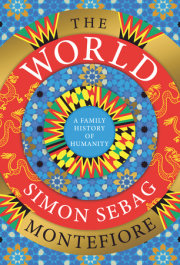
The World

A Family History of Humanity

$35.00 US
Knopf | Vintage
24 per carton
On sale Jun 30, 2026 | 9780593082744
Sales rights: US,CAN,OpnMkt(no EU)

See Additional Formats
NEW YORK TIMES BESTSELLER • A magisterial world history unlike any other that tells the story of humanity through the one thing we all have in common: families • From the author of The Romanovs

A Best Book of the Year: The New Yorker, Smithsonian


Succession meets Game of Thrones.” —The Spectator • “The author brings his cast of dynastic titans, rogues and psychopaths to life...An epic that both entertains and informs.” —
The Economist, Best Books of the Year

Around 950,000 years ago, a family of five walked along the beach and left behind the oldest family footprints ever discovered. For award-winning historian Simon Sebag Montefiore, these poignant, familiar fossils serve as an inspiration for a new kind of world history, one that is genuinely global, spans all eras and all continents, and focuses on the family ties that connect every one of us.

In this epic, ever-surprising book, Montefiore chronicles the world’s great dynasties across human history through palace intrigues, love affairs, and family lives, linking grand themes of war, migration, plague, religion, and technology to the people at the heart of the human drama.

It features a cast of extraordinary diversity: in addition to rulers and conquerors, there are priests, charlatans, artists, scientists, tycoons, gangsters, lovers, husbands, wives, and children. There is Hongwu, the beggar who founded the Ming dynasty; Ewuare, the Leopard-King of Benin; Henry Christophe, King of Haiti; Kamehameha, the conqueror of Hawaii; Zenobia, the Arab empress who defied Rome; Lady Murasaki, the first female novelist; Sayyida al-Hurra, the Moroccan pirate-queen. Here too are moderns such as Indira Gandhi, Margaret Thatcher, Barack Obama, Vladimir Putin, and Volodymyr Zelensky. Here are the Caesars, Medicis and Incas, Ottomans and Mughals, Bonapartes, Habsburgs and Zulus, Rothschilds, Rockefellers and Krupps, Churchills, Kennedys, Castros, Nehrus, Pahlavis and Kenyattas, Saudis, Kims and Assads.

These powerful families represent the breadth of human endeavor, with bloody succession battles, treacherous conspiracies, and shocking megalomania alongside flourishing culture, moving romances, and enlightened benevolence. A dazzling achievement as spellbinding as fiction, The World captures the whole human story in a single, masterful narrative.
INTRODUCTION

As the tide fell, the footsteps emerge. The footsteps of a family walking on the beach of what is now a small village in eastern England, Happisburgh. Five sets of footprints. Probably a male and four children, dating from between 950,000 and 850,000 years before the present. These, discovered in 2013, are the oldest family footprints ever found. They are not the first: even older footprints have been found in Africa, where the human story started. But these are the oldest traces of a family. And they are the inspiration for this history of the world.

There have been many histories of the world, but this one adopts a new approach, using the stories of families across time to provide a different, fresh perspective. It is one that appeals to me because it offers a way of connecting great events with individual human drama, from the first hominins to today, from the sharpened stone to the iPhone and the drone. World history is an elixir for troubled times: its advantage is that it offers a sense of perspective; its drawback is that it involves too much distance. World history often has themes, not people; biography has people, not themes.

The family remains the essential unit of human existence—even in the age of AI and galactical warfare. I have woven history together telling the stories of multiple families in every continent and epoch, using them to tether the onward rush of the human story. It is a biography of many people instead of one person. Even if the span of these families is global, their dramas are intimate—birth, death, marriage, love, hate; they rise; they fall; rise again; they migrate; they return. In every family drama, there are many acts. That is what Samuel Johnson meant when he said every kingdom is a family and every family a little kingdom.

Unlike many of the histories that I grew up with, this is a genuine world history, not unbalanced by excessive focus on Britain and Europe but rather giving Asia, Africa and the Americas the attention they deserve. The focus on family also makes it possible to pay more attention to the lives of women and children, both of whom were slighted in the books I read as a schoolboy. Their roles— like the shape of family itself—change through the arc of time. My aim is to show how the fontanelles of history grew together.

The word family has an air of cosiness and affection, but of course in real life families can be webs of struggle and cruelty too. Many of the families that I follow are power families in which the intimacy and warmth of nurture and love are at once infused and distorted by the peculiar and implacable dynamics of politics. In power families, danger comes from intimacy. ‘Calamity,’ as Han Fei Tzu warned his monarch in second-century bc China, ‘will come to you from those you love.’

‘History is something very few people were doing,’ writes Yuval Noah Harari, ‘when everyone else was ploughing fields and carrying water buckets.’ Many of the families I choose are ones that exercise power, but others encompass enslaved persons, doctors, painters, novelists, executioners, generals, historians, priests, charlatans, scientists, tycoons, criminals—and lovers. Even a few gods.

Some will be familiar, many will not: here we follow the dynasties of Mali, Ming, Medici and Mutapa, Dahomey, Oman, Afghanistan, Cambodia, Brazil and Iran, Haiti, Hawaii and Habsburg; we chronicle Genghis Khan, Sundiata Keita, Empress Wu, Ewuare the Great, Ivan the Terrible, Kim Jong-un, Itzcoatl, Andrew Jackson, King Henry of Haiti, Ganga Zumba, Kaiser Wilhelm, Indira Gandhi, Sobhuza, Pachacuti Inca and Hitler alongside Kenyattas, Castros, Assads and Trumps, Cleopatra, de Gaulle, Khomeini, Gorbachev, Marie Antoinette, Jefferson, Nader, Mao, Obama; Mozart, Balzac and Michelangelo; Caesars, Mughals, Saudis, Roosevelts, Rothschilds, Rockefellers, Ottomans.

The lurid coexists with the cosy. There are many loving fathers and mothers but also ‘Fatso’ Ptolemy IV dismembers his son and sends the parts to the child’s mother; Nader Shah and Empress Iris blind their sons; Queen Isabella tortures her daughter; Charlemagne possibly sleeps with his; Ottoman power mother Kösem orders the strangling of her son and in turn is strangled on the orders of her grandson; Valois potentate Catherine de’ Medici orchestrates a massacre at the wedding of her daughter whose rape by her sons she seems to have condoned; Nero sleeps with his mother, then murders her. Shaka kills his mother, then uses it as a pretext to launch a massacre. Saddam Hussein unleashes his sons against his sons-in-law. The killing of brothers is endemic—even now: Kim Jong-un has recently murdered his brother in a very modern way using a reality-show stunt as cover, a nerve agent as poison.

We follow the tragedies too of teenaged daughters, dispatched by cold parents to marry strangers in faraway lands where they then die in childbirth: sometimes their marriages facilitated affinities between states; more often, their sufferings achieved little since family connections were totally trumped by interests of state. We also follow enslaved women who rise to rule empires; here is Sally Hemings, enslaved half sister of Thomas Jefferson’s late wife, secretly bearing the president’s children; here is Razia of the Delhi sultanate who seizes power as sovereign but is destroyed by her relationship with an African general; in al-Andalus, a caliph’s daughter, Wallada, becomes poetess and libertine. Following our chosen families through pandemics, wars, floods and booms, we chart the lives of women from the village to the throne to the factory and the premiership, from catastrophic maternal mortality and legal impotence to the rights to vote, to abortion and contraception; and the trajectory of children from devastating child mortality to industrialized labour and the modern cult of childhood.

This is a history that focuses on individuals, families and coteries. There are many other ways of approaching history with this span. But I am a historian of power and geopolitics is the engine of world history. I have spent most of my career writing about Russian leaders, and this is the sort of history I have always enjoyed reading—it encompasses passions and furies, the realm of the imagination and senses, and the grit of ordinary life in a way missing from pure economics and political science. The centrality of this human connection is a way of telling the global story that shows the impact of political, economic and technical changes while revealing how families too have evolved. This is another bout in the long struggle between structure and agency, impersonal forces and human character. But these are not necessarily exclusive. ‘Men make their own history,’ wrote Marx, ‘but they don’t make it as they please; they don’t make it under self-selected circumstances, but under circumstances existing already, given and transmitted from the past.’ So often history is presented as a staccato series of events, revolutions and paradigms, experienced by neatly categorized, narrowly identified people. Yet the lives of real families reveal something different—idiosyncratic, singular people living, laughing, loving over decades and centuries in a layered, hybrid, liminal, kaleidoscopic world that defies the categories and identities of later times.

The families and characters I follow here tend to be exceptional—but they also reveal much about their era and place. It is a way of looking at how kingdoms and states evolved, at how the interconnectivity of peoples developed, and at how different societies absorbed outsiders and merged with others. In this multifaceted drama, I hope that the simultaneous, blended yet single narrative catches something of the messy unpredictability and contingency of real life in real time, the feeling that much is happening in different places and orbits, the mayhem and the confusion of a dizzying, spasmodic, bare-knuckle cavalry charge, often as absurd as it is cruel, always filled with vertiginous surprises, strange incidents and incredible personalities that no one could foresee. That’s why the most successful leaders are visionaries, transcendent strategists but also improvisers, opportunists, creatures of bungle and luck. ‘Even the shrewdest of the shrewd,’ admitted Bismark ‘goes like a child into the dark.’ History is made by the interplay of ideas, institutions and geopolitics. When they come together in felicitous conjunction, great changes happen. But even then, it is personalities who roll the dice....
Named One of the Best Books of the Year by The New Yorker and The Economist • The Times (UK) History Book of the Year • Smithsonian Magazine Best History Book of the Year • Kirkus Best Nonfiction Book of the Year

The World tells the story of humanity through families, be they large or small, powerful or weak, rich or poor. It is a book for people who want to read about people. . . . The World pulsates with the hundreds of human stories Mr. Montefiore brings to life in vivid, convincing fashion. . . . Montefiore is a biographer at heart. Combining literary flair with keen insight into human psychology, he can evoke a person with a few choice words. . . . Among the many strengths of The World is its truly global perspective. This is an unabashedly multicultural history that refuses to privilege any particular perspective, be it geographic, cultural or ethnic.” —The Wall Street Journal

“A monumental survey of dynastic rule: how to get it, how to keep it, how to squander it. . . . Montefiore energetically fulfills his promise to write a ‘genuine world history, not unbalanced by excessive focus on Britain and Europe.’ In zesty sentences and lively vignettes, he captures the widening global circuits of people, commerce, and culture.” —The New Yorker

"Simon Sebag Montefiore knows how to keep our attention. . . . He makes certain to pepper The World with enough inventive gore, twisted villainy, and seriously kinky sex to keep those pages turning. . . . Montefiore’s accomplishment here is nothing short of breathtaking. It is no mean feat to create a comprehensive timeline of human history that is deeply researched, illuminating, addictively compelling, and—quite simply—a rowdy good time.” —The Washington Independent Review of Books

“A delightful world history, told through influential families. . . . There is never a dull moment. . . . A triumph and a delight, an epic that entertains, informs and appalls in enjoyably equal measure.” The Economist

“A staggering achievement. Simon Sebag Montefiore has given us a tremendous gift: a pulsingly readable world history through the millennia and from one end of the globe to the other.” —Sir Simon Schama, author of The Story of the Jews

“A tour de force. Hugely ambitious, erudite and filled with surprises. This puts the family and families back into the heart of history.” —Peter Frankopan, New York Times best-selling author of Silk Roads

“Important and mesmerizing." —Michael Beschloss, New York Times best-selling author of Presidents of War

“Compelling, moving, epic, and diverse, Montefiore’s wonderful storytelling prowess and wide research pulls off this unparalleled world history in a single narrative with unforgettable style. All the drama of humankind is here from cavemen to Putin and Zelensky.” —Olivette Otele, author of African Europeans

“One word for Montefiore’s book: magisterial.” —Ben Okri, Booker Prize–winning author of The Famished Road

“In this work of astonishing scope and erudition, Simon Sebag Montefiore interweaves the stories of the servants, courtiers, and kings, pioneers, preachers, and philosophers who have made history. A brilliant synthesis that will impart fresh insight to even the most learned readers.” —Henry Kissinger, former U.S. Secretary of State

“Simon Sebag Montefiore took on the ambitious task of telling the story of mankind throughout time which he accomplished in splendid fashion! The World is a brilliant book, and its examination of our species’ experiences through the prism of the family is truly inspired.” —General David Petraeus (US Army, Ret.); former Director of the CIA

“There is a certain satisfaction in holding, and reading a bulky tome. Simon Sebag Montefiore's The World requires strong wrists, but is well worth the physical effort. It is a most readable and fascinating history of humanity from the perspective of that most enduring of institutions: the family. There is pleasure and learning on every [page].” ―Alexander McCall Smith, New Statesman, Books of the Year 2022

“A rollicking, globetrotting. . . . A thrilling tapestry. Only a highly skilled storyteller and pen-portraitist could so deftly grip attention across twenty-three ‘acts’, spanning more than six millennia and packed with lavish and pullulating detail. . . . The World is wildly entertaining . . . certainly enriching and bracingly profane.” Times Literary Supplement

“A riveting page-turner. The author brings his cast of dynastic titans, rogues and psychopaths to life with pithy, witty pen portraits, ladling on the sex and violence. An epic that both entertains and informs.” The Economist, Best Books of 2022

“Magnificent. . . . [A] magisterial tome. . . . Dip into this book anywhere and the minutiae of history leap off the page. . . . [A] real-life Game of Thrones.” The Daily Mail, Book of the Week

“A rollicking tale, a kaleidoscope of savagery, sex, cruelty and chaos. . . . Montefiore provides an intimacy usually lacking in global histories. . . . [The World] has personality and a soul. It's also outrageously funny. . . . An enormously entertaining book.” The Times (UK), History Book of the Year

“Deserves to be a roaring bestseller. . . . Think Succession meets Game of Thrones, history told through dynasty and intrigue and written with wit, insight, and more than a dash of scandal.” The Spectator

“Dip into any page and you'll find history rushing by in prose that combines clarity, liveliness and even deadpan humour with intriguing little asides a specialty. . . . A staggering achievement.” Daily Telegraph

“This is not just an undoubted book of the year but of many years. . . . It's a treasure trove of marvellous stories, brilliantly researched and absorbingly told, fascinating characters who leap off thepages but, above all, the thing missing most in our troubled, self-absorbed society—perspective.” Daily Mail

“It is hard to stop turning the pages. . . . There is no doubting that family is the central institution of human history and Montefiore's overview of its most recent five millennia is entertaining and consistently interesting.” Financial Times

“Succeeds in scintillating fashion . . . . [A]n epic rich in detail . . . . [O]n each page, you'll find an interesting idea, a witty observation or a footnote containing an anecdote emblematic of a wider point. Montefiore pays attention to the lives of women and children and to places slighted by Western historians. . . . This is an extraordinary work of wisdom and vivid storytelling.” Literary Review

“[Montefiore’s] major achievement is to make us see the world through a different lens - to make theunfamiliar familiar and, more important, the familiar unfamiliar. . . . [B]rings [history] most vividly, almost feverishly, to life. There is hardly a dull paragraph.” The Spectator

“[A]n incredible undertaking. Montefiore finds enduring resonances and offers new perspectives . . . . Because these are family stories, he adeptly eschews traditionally male histories to find greater texture and diversity. A remarkable achievement.” Observer

“Violence, treachery, and sex are the motors of history in this sweeping chronicle. . . . Setting a whirlwind pace, Montefiore skillfully guides readers through the tumult with elegant prose and evocative character sketches. It’s a bravura performance.” Publishers Weekly (starred review)

“Award-winning historian Montefiore draws on 30 years of research, reading, and travel to create a panoramic, abundantly populated, richly detailed history of the world through the stories of families across place and time. . . . A vibrant, masterful rendering of human history.” Kirkus Reviews (starred review)

"History buffs and novices will appreciate this extensive, accessible, highly recommended work; it may inspire them to dig into lesser-known areas of global history." Library Journal (starred review)

About

NEW YORK TIMES BESTSELLER • A magisterial world history unlike any other that tells the story of humanity through the one thing we all have in common: families • From the author of The Romanovs

A Best Book of the Year: The New Yorker, Smithsonian


Succession meets Game of Thrones.” —The Spectator • “The author brings his cast of dynastic titans, rogues and psychopaths to life...An epic that both entertains and informs.” —
The Economist, Best Books of the Year

Around 950,000 years ago, a family of five walked along the beach and left behind the oldest family footprints ever discovered. For award-winning historian Simon Sebag Montefiore, these poignant, familiar fossils serve as an inspiration for a new kind of world history, one that is genuinely global, spans all eras and all continents, and focuses on the family ties that connect every one of us.

In this epic, ever-surprising book, Montefiore chronicles the world’s great dynasties across human history through palace intrigues, love affairs, and family lives, linking grand themes of war, migration, plague, religion, and technology to the people at the heart of the human drama.

It features a cast of extraordinary diversity: in addition to rulers and conquerors, there are priests, charlatans, artists, scientists, tycoons, gangsters, lovers, husbands, wives, and children. There is Hongwu, the beggar who founded the Ming dynasty; Ewuare, the Leopard-King of Benin; Henry Christophe, King of Haiti; Kamehameha, the conqueror of Hawaii; Zenobia, the Arab empress who defied Rome; Lady Murasaki, the first female novelist; Sayyida al-Hurra, the Moroccan pirate-queen. Here too are moderns such as Indira Gandhi, Margaret Thatcher, Barack Obama, Vladimir Putin, and Volodymyr Zelensky. Here are the Caesars, Medicis and Incas, Ottomans and Mughals, Bonapartes, Habsburgs and Zulus, Rothschilds, Rockefellers and Krupps, Churchills, Kennedys, Castros, Nehrus, Pahlavis and Kenyattas, Saudis, Kims and Assads.

These powerful families represent the breadth of human endeavor, with bloody succession battles, treacherous conspiracies, and shocking megalomania alongside flourishing culture, moving romances, and enlightened benevolence. A dazzling achievement as spellbinding as fiction, The World captures the whole human story in a single, masterful narrative.

Excerpt

INTRODUCTION

As the tide fell, the footsteps emerge. The footsteps of a family walking on the beach of what is now a small village in eastern England, Happisburgh. Five sets of footprints. Probably a male and four children, dating from between 950,000 and 850,000 years before the present. These, discovered in 2013, are the oldest family footprints ever found. They are not the first: even older footprints have been found in Africa, where the human story started. But these are the oldest traces of a family. And they are the inspiration for this history of the world.

There have been many histories of the world, but this one adopts a new approach, using the stories of families across time to provide a different, fresh perspective. It is one that appeals to me because it offers a way of connecting great events with individual human drama, from the first hominins to today, from the sharpened stone to the iPhone and the drone. World history is an elixir for troubled times: its advantage is that it offers a sense of perspective; its drawback is that it involves too much distance. World history often has themes, not people; biography has people, not themes.

The family remains the essential unit of human existence—even in the age of AI and galactical warfare. I have woven history together telling the stories of multiple families in every continent and epoch, using them to tether the onward rush of the human story. It is a biography of many people instead of one person. Even if the span of these families is global, their dramas are intimate—birth, death, marriage, love, hate; they rise; they fall; rise again; they migrate; they return. In every family drama, there are many acts. That is what Samuel Johnson meant when he said every kingdom is a family and every family a little kingdom.

Unlike many of the histories that I grew up with, this is a genuine world history, not unbalanced by excessive focus on Britain and Europe but rather giving Asia, Africa and the Americas the attention they deserve. The focus on family also makes it possible to pay more attention to the lives of women and children, both of whom were slighted in the books I read as a schoolboy. Their roles— like the shape of family itself—change through the arc of time. My aim is to show how the fontanelles of history grew together.

The word family has an air of cosiness and affection, but of course in real life families can be webs of struggle and cruelty too. Many of the families that I follow are power families in which the intimacy and warmth of nurture and love are at once infused and distorted by the peculiar and implacable dynamics of politics. In power families, danger comes from intimacy. ‘Calamity,’ as Han Fei Tzu warned his monarch in second-century bc China, ‘will come to you from those you love.’

‘History is something very few people were doing,’ writes Yuval Noah Harari, ‘when everyone else was ploughing fields and carrying water buckets.’ Many of the families I choose are ones that exercise power, but others encompass enslaved persons, doctors, painters, novelists, executioners, generals, historians, priests, charlatans, scientists, tycoons, criminals—and lovers. Even a few gods.

Some will be familiar, many will not: here we follow the dynasties of Mali, Ming, Medici and Mutapa, Dahomey, Oman, Afghanistan, Cambodia, Brazil and Iran, Haiti, Hawaii and Habsburg; we chronicle Genghis Khan, Sundiata Keita, Empress Wu, Ewuare the Great, Ivan the Terrible, Kim Jong-un, Itzcoatl, Andrew Jackson, King Henry of Haiti, Ganga Zumba, Kaiser Wilhelm, Indira Gandhi, Sobhuza, Pachacuti Inca and Hitler alongside Kenyattas, Castros, Assads and Trumps, Cleopatra, de Gaulle, Khomeini, Gorbachev, Marie Antoinette, Jefferson, Nader, Mao, Obama; Mozart, Balzac and Michelangelo; Caesars, Mughals, Saudis, Roosevelts, Rothschilds, Rockefellers, Ottomans.

The lurid coexists with the cosy. There are many loving fathers and mothers but also ‘Fatso’ Ptolemy IV dismembers his son and sends the parts to the child’s mother; Nader Shah and Empress Iris blind their sons; Queen Isabella tortures her daughter; Charlemagne possibly sleeps with his; Ottoman power mother Kösem orders the strangling of her son and in turn is strangled on the orders of her grandson; Valois potentate Catherine de’ Medici orchestrates a massacre at the wedding of her daughter whose rape by her sons she seems to have condoned; Nero sleeps with his mother, then murders her. Shaka kills his mother, then uses it as a pretext to launch a massacre. Saddam Hussein unleashes his sons against his sons-in-law. The killing of brothers is endemic—even now: Kim Jong-un has recently murdered his brother in a very modern way using a reality-show stunt as cover, a nerve agent as poison.

We follow the tragedies too of teenaged daughters, dispatched by cold parents to marry strangers in faraway lands where they then die in childbirth: sometimes their marriages facilitated affinities between states; more often, their sufferings achieved little since family connections were totally trumped by interests of state. We also follow enslaved women who rise to rule empires; here is Sally Hemings, enslaved half sister of Thomas Jefferson’s late wife, secretly bearing the president’s children; here is Razia of the Delhi sultanate who seizes power as sovereign but is destroyed by her relationship with an African general; in al-Andalus, a caliph’s daughter, Wallada, becomes poetess and libertine. Following our chosen families through pandemics, wars, floods and booms, we chart the lives of women from the village to the throne to the factory and the premiership, from catastrophic maternal mortality and legal impotence to the rights to vote, to abortion and contraception; and the trajectory of children from devastating child mortality to industrialized labour and the modern cult of childhood.

This is a history that focuses on individuals, families and coteries. There are many other ways of approaching history with this span. But I am a historian of power and geopolitics is the engine of world history. I have spent most of my career writing about Russian leaders, and this is the sort of history I have always enjoyed reading—it encompasses passions and furies, the realm of the imagination and senses, and the grit of ordinary life in a way missing from pure economics and political science. The centrality of this human connection is a way of telling the global story that shows the impact of political, economic and technical changes while revealing how families too have evolved. This is another bout in the long struggle between structure and agency, impersonal forces and human character. But these are not necessarily exclusive. ‘Men make their own history,’ wrote Marx, ‘but they don’t make it as they please; they don’t make it under self-selected circumstances, but under circumstances existing already, given and transmitted from the past.’ So often history is presented as a staccato series of events, revolutions and paradigms, experienced by neatly categorized, narrowly identified people. Yet the lives of real families reveal something different—idiosyncratic, singular people living, laughing, loving over decades and centuries in a layered, hybrid, liminal, kaleidoscopic world that defies the categories and identities of later times.

The families and characters I follow here tend to be exceptional—but they also reveal much about their era and place. It is a way of looking at how kingdoms and states evolved, at how the interconnectivity of peoples developed, and at how different societies absorbed outsiders and merged with others. In this multifaceted drama, I hope that the simultaneous, blended yet single narrative catches something of the messy unpredictability and contingency of real life in real time, the feeling that much is happening in different places and orbits, the mayhem and the confusion of a dizzying, spasmodic, bare-knuckle cavalry charge, often as absurd as it is cruel, always filled with vertiginous surprises, strange incidents and incredible personalities that no one could foresee. That’s why the most successful leaders are visionaries, transcendent strategists but also improvisers, opportunists, creatures of bungle and luck. ‘Even the shrewdest of the shrewd,’ admitted Bismark ‘goes like a child into the dark.’ History is made by the interplay of ideas, institutions and geopolitics. When they come together in felicitous conjunction, great changes happen. But even then, it is personalities who roll the dice....

Praise

Named One of the Best Books of the Year by The New Yorker and The Economist • The Times (UK) History Book of the Year • Smithsonian Magazine Best History Book of the Year • Kirkus Best Nonfiction Book of the Year

The World tells the story of humanity through families, be they large or small, powerful or weak, rich or poor. It is a book for people who want to read about people. . . . The World pulsates with the hundreds of human stories Mr. Montefiore brings to life in vivid, convincing fashion. . . . Montefiore is a biographer at heart. Combining literary flair with keen insight into human psychology, he can evoke a person with a few choice words. . . . Among the many strengths of The World is its truly global perspective. This is an unabashedly multicultural history that refuses to privilege any particular perspective, be it geographic, cultural or ethnic.” —The Wall Street Journal

“A monumental survey of dynastic rule: how to get it, how to keep it, how to squander it. . . . Montefiore energetically fulfills his promise to write a ‘genuine world history, not unbalanced by excessive focus on Britain and Europe.’ In zesty sentences and lively vignettes, he captures the widening global circuits of people, commerce, and culture.” —The New Yorker

"Simon Sebag Montefiore knows how to keep our attention. . . . He makes certain to pepper The World with enough inventive gore, twisted villainy, and seriously kinky sex to keep those pages turning. . . . Montefiore’s accomplishment here is nothing short of breathtaking. It is no mean feat to create a comprehensive timeline of human history that is deeply researched, illuminating, addictively compelling, and—quite simply—a rowdy good time.” —The Washington Independent Review of Books

“A delightful world history, told through influential families. . . . There is never a dull moment. . . . A triumph and a delight, an epic that entertains, informs and appalls in enjoyably equal measure.” The Economist

“A staggering achievement. Simon Sebag Montefiore has given us a tremendous gift: a pulsingly readable world history through the millennia and from one end of the globe to the other.” —Sir Simon Schama, author of The Story of the Jews

“A tour de force. Hugely ambitious, erudite and filled with surprises. This puts the family and families back into the heart of history.” —Peter Frankopan, New York Times best-selling author of Silk Roads

“Important and mesmerizing." —Michael Beschloss, New York Times best-selling author of Presidents of War

“Compelling, moving, epic, and diverse, Montefiore’s wonderful storytelling prowess and wide research pulls off this unparalleled world history in a single narrative with unforgettable style. All the drama of humankind is here from cavemen to Putin and Zelensky.” —Olivette Otele, author of African Europeans

“One word for Montefiore’s book: magisterial.” —Ben Okri, Booker Prize–winning author of The Famished Road

“In this work of astonishing scope and erudition, Simon Sebag Montefiore interweaves the stories of the servants, courtiers, and kings, pioneers, preachers, and philosophers who have made history. A brilliant synthesis that will impart fresh insight to even the most learned readers.” —Henry Kissinger, former U.S. Secretary of State

“Simon Sebag Montefiore took on the ambitious task of telling the story of mankind throughout time which he accomplished in splendid fashion! The World is a brilliant book, and its examination of our species’ experiences through the prism of the family is truly inspired.” —General David Petraeus (US Army, Ret.); former Director of the CIA

“There is a certain satisfaction in holding, and reading a bulky tome. Simon Sebag Montefiore's The World requires strong wrists, but is well worth the physical effort. It is a most readable and fascinating history of humanity from the perspective of that most enduring of institutions: the family. There is pleasure and learning on every [page].” ―Alexander McCall Smith, New Statesman, Books of the Year 2022

“A rollicking, globetrotting. . . . A thrilling tapestry. Only a highly skilled storyteller and pen-portraitist could so deftly grip attention across twenty-three ‘acts’, spanning more than six millennia and packed with lavish and pullulating detail. . . . The World is wildly entertaining . . . certainly enriching and bracingly profane.” Times Literary Supplement

“A riveting page-turner. The author brings his cast of dynastic titans, rogues and psychopaths to life with pithy, witty pen portraits, ladling on the sex and violence. An epic that both entertains and informs.” The Economist, Best Books of 2022

“Magnificent. . . . [A] magisterial tome. . . . Dip into this book anywhere and the minutiae of history leap off the page. . . . [A] real-life Game of Thrones.” The Daily Mail, Book of the Week

“A rollicking tale, a kaleidoscope of savagery, sex, cruelty and chaos. . . . Montefiore provides an intimacy usually lacking in global histories. . . . [The World] has personality and a soul. It's also outrageously funny. . . . An enormously entertaining book.” The Times (UK), History Book of the Year

“Deserves to be a roaring bestseller. . . . Think Succession meets Game of Thrones, history told through dynasty and intrigue and written with wit, insight, and more than a dash of scandal.” The Spectator

“Dip into any page and you'll find history rushing by in prose that combines clarity, liveliness and even deadpan humour with intriguing little asides a specialty. . . . A staggering achievement.” Daily Telegraph

“This is not just an undoubted book of the year but of many years. . . . It's a treasure trove of marvellous stories, brilliantly researched and absorbingly told, fascinating characters who leap off thepages but, above all, the thing missing most in our troubled, self-absorbed society—perspective.” Daily Mail

“It is hard to stop turning the pages. . . . There is no doubting that family is the central institution of human history and Montefiore's overview of its most recent five millennia is entertaining and consistently interesting.” Financial Times

“Succeeds in scintillating fashion . . . . [A]n epic rich in detail . . . . [O]n each page, you'll find an interesting idea, a witty observation or a footnote containing an anecdote emblematic of a wider point. Montefiore pays attention to the lives of women and children and to places slighted by Western historians. . . . This is an extraordinary work of wisdom and vivid storytelling.” Literary Review

“[Montefiore’s] major achievement is to make us see the world through a different lens - to make theunfamiliar familiar and, more important, the familiar unfamiliar. . . . [B]rings [history] most vividly, almost feverishly, to life. There is hardly a dull paragraph.” The Spectator

“[A]n incredible undertaking. Montefiore finds enduring resonances and offers new perspectives . . . . Because these are family stories, he adeptly eschews traditionally male histories to find greater texture and diversity. A remarkable achievement.” Observer

“Violence, treachery, and sex are the motors of history in this sweeping chronicle. . . . Setting a whirlwind pace, Montefiore skillfully guides readers through the tumult with elegant prose and evocative character sketches. It’s a bravura performance.” Publishers Weekly (starred review)

“Award-winning historian Montefiore draws on 30 years of research, reading, and travel to create a panoramic, abundantly populated, richly detailed history of the world through the stories of families across place and time. . . . A vibrant, masterful rendering of human history.” Kirkus Reviews (starred review)

"History buffs and novices will appreciate this extensive, accessible, highly recommended work; it may inspire them to dig into lesser-known areas of global history." Library Journal (starred review)