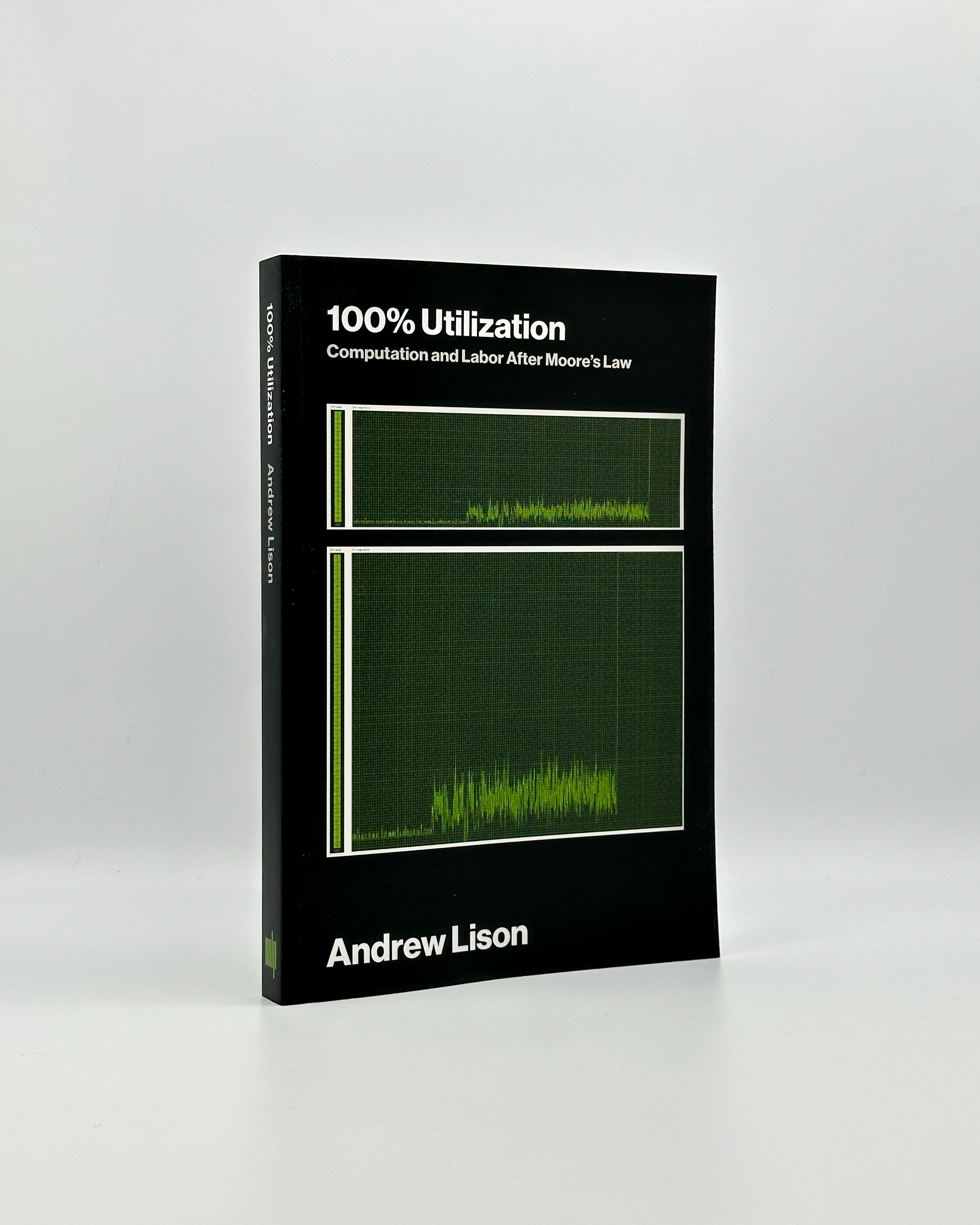
100% Utilization

Computation and Labor After Moore's Law

Look inside
Paperback
$60.00 US
The MIT Press
28 per carton
On sale May 26, 2026 | 9780262051361
Sales rights: World

See Additional Formats
A wide-ranging analysis of how the material limits to discrete, silicon-based computing power impact employment and automation.

Since the end of the Second World War, we have come to expect continual growth in computing power and the rapid development of digital technology. This dynamic has enabled informational procedures to supplant an ever-increasing range of human and mechanical activity. However, indications that the semiconductor industry is approaching the physical limits of integrated circuitry pose an existential challenge to Intel Corporation cofounder Gordon Moore’s “law,” which prescribes an exponential increase in microchip density—and, by extension, processing performance—every two years.

Placing theories of employment in dialectical conjunction with the concrete operations of computing, 100% Utilization explores the consequences of pushing processing power to its limits for a culture seemingly reliant on automation as much as human labor. In accounting for this contradiction, Andrew Lison offers a corrective to theories of digital mediation emphasizing its symbolic and representational capabilities. He connects the looming end of Moore’s law to trends in semiconductor manufacturing, custom hardware, and parallelized software techniques, including AI. Ultimately, he traces this historical technological boom and impending bust through the racialized history of Silicon Valley to longer-term conceptions of the relationship between machinery and labor.
TABLE OF CONTENTS
Introduction The Ground Truth of Digital Mediation 1
Chapter 1 Approaching 100% Utilization 32
Chapter 2 Economies and Scales: Producing and Consuming Computing Power 67
Chapter 3 Squeezing Silicon: From Software Control to Hardware Efficiency 103
Chapter 4 Convolute N(eural): Overused AI and Underemployed Minds 151
Chapter 5 Winter in the Valley: The Accelerating Dynamics of Stagnation 191
Chapter 6 Beyond Homeostasis 242
Conclusion Indeterminate Elements 279

additional book photo
ENDORSEMENTS

"100% Utilization urges us to think beyond the limits of the convergence of the microelectronic and the macroeconomic: not by concentrating power but in politically and technically experimental ways. 100% essential."
—Matthew Fuller, coauthor of Evil Media

"100% Utilization is a brilliant book that vividly paints the present and future of the material limits of computation and the end of Moore’s law. Technical expertise, cultural analysis, media theory, and materialist analysis combine here in an effective and forward-looking analysis of our technological times. This book is a must-read."
—Marc Steinberg, author of Anime’s Media Fix and The Platform Economy

“Lison’s is a trenchant analysis of Moore’s law in decline, and its implications. It’s also something of a unicorn: clear and rigorous on technology, Marxist political economy, and cultural analysis alike. I learned a lot.”
—David C. Brock, Robert and Bette Finnigan Fellow, Computer History Museum

About

A wide-ranging analysis of how the material limits to discrete, silicon-based computing power impact employment and automation.

Since the end of the Second World War, we have come to expect continual growth in computing power and the rapid development of digital technology. This dynamic has enabled informational procedures to supplant an ever-increasing range of human and mechanical activity. However, indications that the semiconductor industry is approaching the physical limits of integrated circuitry pose an existential challenge to Intel Corporation cofounder Gordon Moore’s “law,” which prescribes an exponential increase in microchip density—and, by extension, processing performance—every two years.

Placing theories of employment in dialectical conjunction with the concrete operations of computing, 100% Utilization explores the consequences of pushing processing power to its limits for a culture seemingly reliant on automation as much as human labor. In accounting for this contradiction, Andrew Lison offers a corrective to theories of digital mediation emphasizing its symbolic and representational capabilities. He connects the looming end of Moore’s law to trends in semiconductor manufacturing, custom hardware, and parallelized software techniques, including AI. Ultimately, he traces this historical technological boom and impending bust through the racialized history of Silicon Valley to longer-term conceptions of the relationship between machinery and labor.

Table of Contents

TABLE OF CONTENTS
Introduction The Ground Truth of Digital Mediation 1
Chapter 1 Approaching 100% Utilization 32
Chapter 2 Economies and Scales: Producing and Consuming Computing Power 67
Chapter 3 Squeezing Silicon: From Software Control to Hardware Efficiency 103
Chapter 4 Convolute N(eural): Overused AI and Underemployed Minds 151
Chapter 5 Winter in the Valley: The Accelerating Dynamics of Stagnation 191
Chapter 6 Beyond Homeostasis 242
Conclusion Indeterminate Elements 279

Photos

additional book photo

Praise

ENDORSEMENTS

"100% Utilization urges us to think beyond the limits of the convergence of the microelectronic and the macroeconomic: not by concentrating power but in politically and technically experimental ways. 100% essential."
—Matthew Fuller, coauthor of Evil Media

"100% Utilization is a brilliant book that vividly paints the present and future of the material limits of computation and the end of Moore’s law. Technical expertise, cultural analysis, media theory, and materialist analysis combine here in an effective and forward-looking analysis of our technological times. This book is a must-read."
—Marc Steinberg, author of Anime’s Media Fix and The Platform Economy

“Lison’s is a trenchant analysis of Moore’s law in decline, and its implications. It’s also something of a unicorn: clear and rigorous on technology, Marxist political economy, and cultural analysis alike. I learned a lot.”
—David C. Brock, Robert and Bette Finnigan Fellow, Computer History Museum