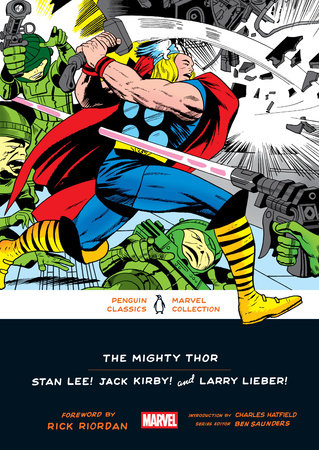
The Mighty Thor

Foreword by Rick Riordan
Introduction by Charles Hatfield
Series edited by Ben Saunders
$30.00 US
Penguin Adult HC/TR | Penguin Classics
12 per carton
On sale Sep 15, 2026 | 9780143138273
Sales rights: World

The Penguin Classics Marvel Collection presents the origin stories, seminal tales, and characters of the Marvel Universe to explore Marvel’s transformative and timeless influence on an entire genre of fantasy

Collects Journey into Mystery #83, 85, and 114-116, and Thor #128-133, 154-157, and 159-161. It is impossible to imagine American popular culture without Marvel Comics. For decades, Marvel has published groundbreaking visual narratives that sustain attention on multiple levels: as metaphors for the experience of difference and otherness; as meditations on the fluid nature of identity; and as high-water marks in the artistic tradition of American cartooning, to name a few.

During the 1960s, under the hands of the inimitable creative team of Jack Kirby, Stan Lee, and Larry Lieber, Marvel’s Thor combined the raw material of ancient Norse mythology with the nonstop action of super-heroic adventure comics and the speculative reach of classic science fiction. The result was a heady brew: epic, operatic, melodramatic, even psychedelic. This collection gathers some of the most important story arcs from the foundational years of the series and includes seminal early appearances of such characters as Hercules and Ego, the Living Planet, as well as Thor’s first encounter with Galactus.

A foreword by Rick Riordan and scholarly introductions and apparatus by Charles Hatfield and Ben Saunders offer further insight into the enduring significance of The Mighty Thor and classic Marvel comics.
“A groundbreaking example of comics representation in literature.”
Publishers Weekly

“Penguin provides introductory essays; superb analyses by the series editor, Ben Saunders; and extensive bibliographies.”
—Michael Dirda, The Washington Post

“Stories become classics when generations of readers sort through them, talk about them, imitate them, and recommend them. In this case, baby boomers read them when they débuted, Gen X-ers grew up with their sequels, and millennials encountered them through Marvel movies. Each generation of fans—initially fanboys, increasingly fangirls, and these days nonbinary fans, too—found new ways not just to read the comics but to use them. That’s how canons form. Amateurs and professionals, over decades, come to something like consensus about which books matter and why—or else they love to argue about it, and we get to follow the arguments. Canons rise and fall, gain works and lose others, when one generation of people with the power to publish, teach, and edit diverges from the one before ... A top-flight comic by Kirby—or his successor on “Captain America,” Jim Steranko—barely needed words. You could follow the story just by watching the characters act and react. Thankfully, Penguin volumes do justice to these images. They reproduce sixties comics in bright, flat, colorful inks on thick white paper—unlike the dot-based process used on old newsprint, but perhaps truer to their bold, thrill-chasing spirit.”
—Stephanie Burt, The New Yorker

About

The Penguin Classics Marvel Collection presents the origin stories, seminal tales, and characters of the Marvel Universe to explore Marvel’s transformative and timeless influence on an entire genre of fantasy

Collects Journey into Mystery #83, 85, and 114-116, and Thor #128-133, 154-157, and 159-161. It is impossible to imagine American popular culture without Marvel Comics. For decades, Marvel has published groundbreaking visual narratives that sustain attention on multiple levels: as metaphors for the experience of difference and otherness; as meditations on the fluid nature of identity; and as high-water marks in the artistic tradition of American cartooning, to name a few.

During the 1960s, under the hands of the inimitable creative team of Jack Kirby, Stan Lee, and Larry Lieber, Marvel’s Thor combined the raw material of ancient Norse mythology with the nonstop action of super-heroic adventure comics and the speculative reach of classic science fiction. The result was a heady brew: epic, operatic, melodramatic, even psychedelic. This collection gathers some of the most important story arcs from the foundational years of the series and includes seminal early appearances of such characters as Hercules and Ego, the Living Planet, as well as Thor’s first encounter with Galactus.

A foreword by Rick Riordan and scholarly introductions and apparatus by Charles Hatfield and Ben Saunders offer further insight into the enduring significance of The Mighty Thor and classic Marvel comics.

Praise

“A groundbreaking example of comics representation in literature.”
Publishers Weekly

“Penguin provides introductory essays; superb analyses by the series editor, Ben Saunders; and extensive bibliographies.”
—Michael Dirda, The Washington Post

“Stories become classics when generations of readers sort through them, talk about them, imitate them, and recommend them. In this case, baby boomers read them when they débuted, Gen X-ers grew up with their sequels, and millennials encountered them through Marvel movies. Each generation of fans—initially fanboys, increasingly fangirls, and these days nonbinary fans, too—found new ways not just to read the comics but to use them. That’s how canons form. Amateurs and professionals, over decades, come to something like consensus about which books matter and why—or else they love to argue about it, and we get to follow the arguments. Canons rise and fall, gain works and lose others, when one generation of people with the power to publish, teach, and edit diverges from the one before ... A top-flight comic by Kirby—or his successor on “Captain America,” Jim Steranko—barely needed words. You could follow the story just by watching the characters act and react. Thankfully, Penguin volumes do justice to these images. They reproduce sixties comics in bright, flat, colorful inks on thick white paper—unlike the dot-based process used on old newsprint, but perhaps truer to their bold, thrill-chasing spirit.”
—Stephanie Burt, The New Yorker